When can babies see? The first year, month by month
Your newborn already sees you, just not the way you expect. Here is the quiet, ordinary unfolding of sight across the first year, and the small things worth a smile, or a second look.

- A newborn's sharpest focus is about 20 to 30cm away, roughly the distance to your face when you feed them. They can see across a room from birth, but detail beyond that is blurred.
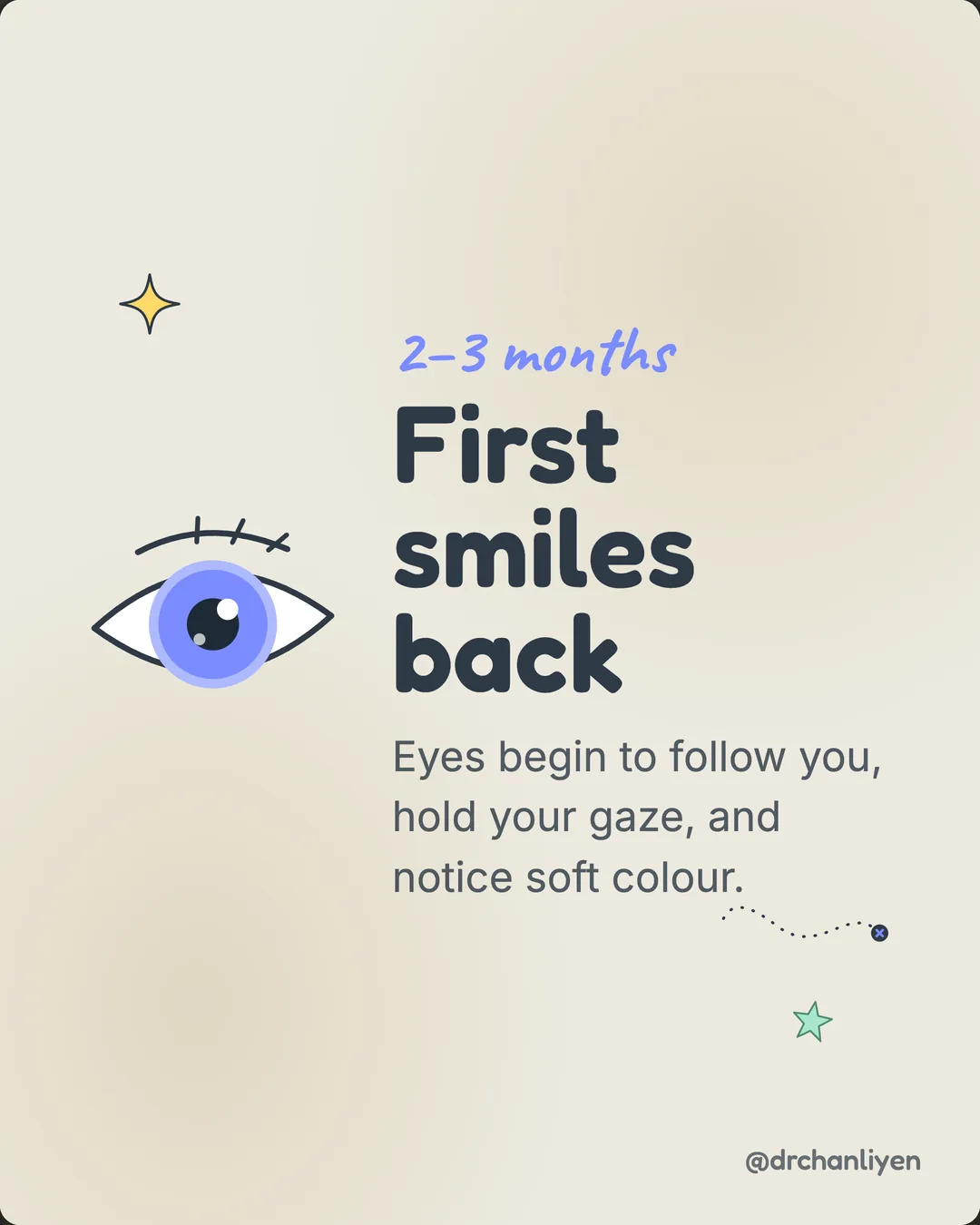
- By around three months the eyes should work together and follow a face or toy smoothly, without a constant turn.
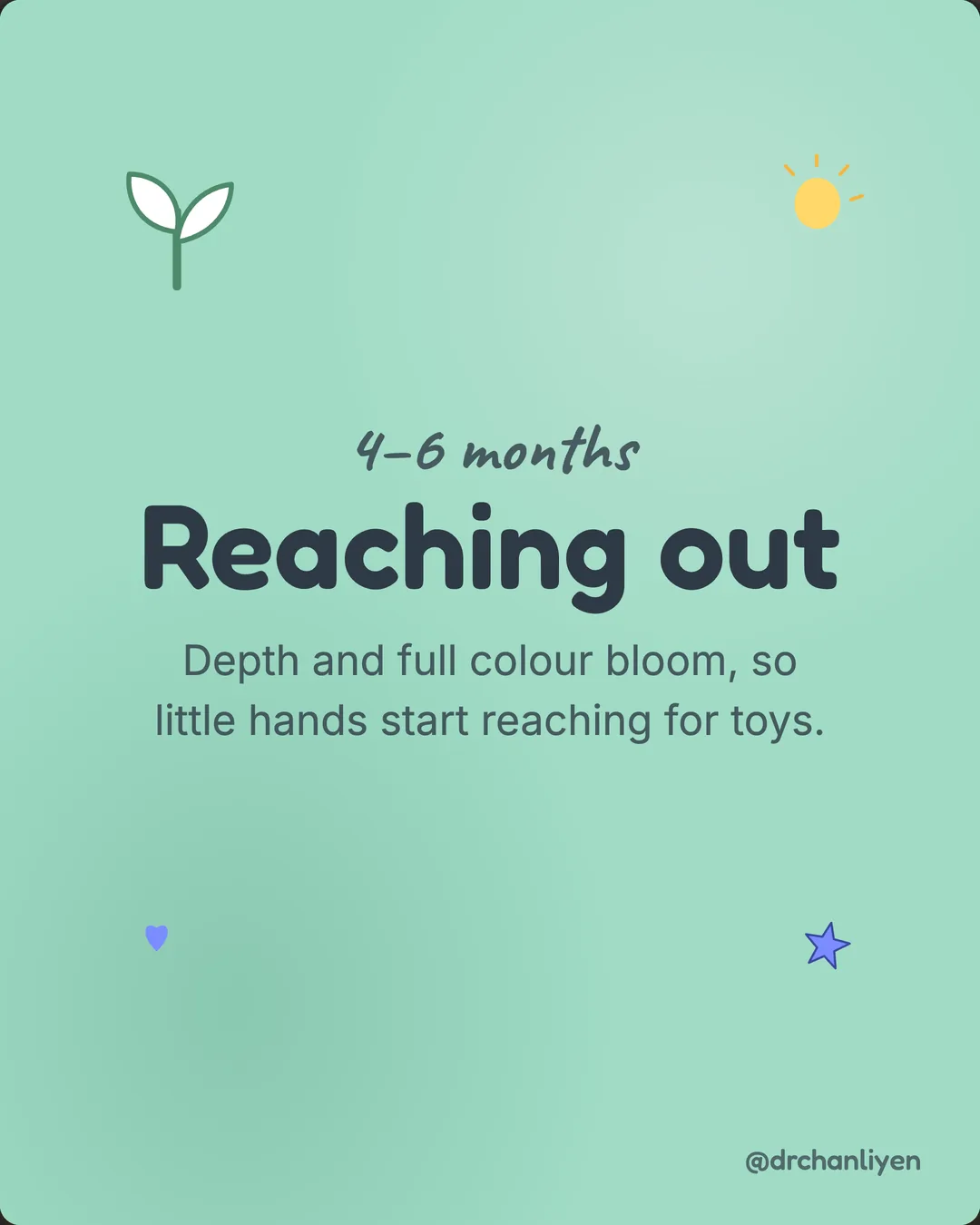
- By four months babies usually reach for what they see, and colour and depth are coming together by about five months.
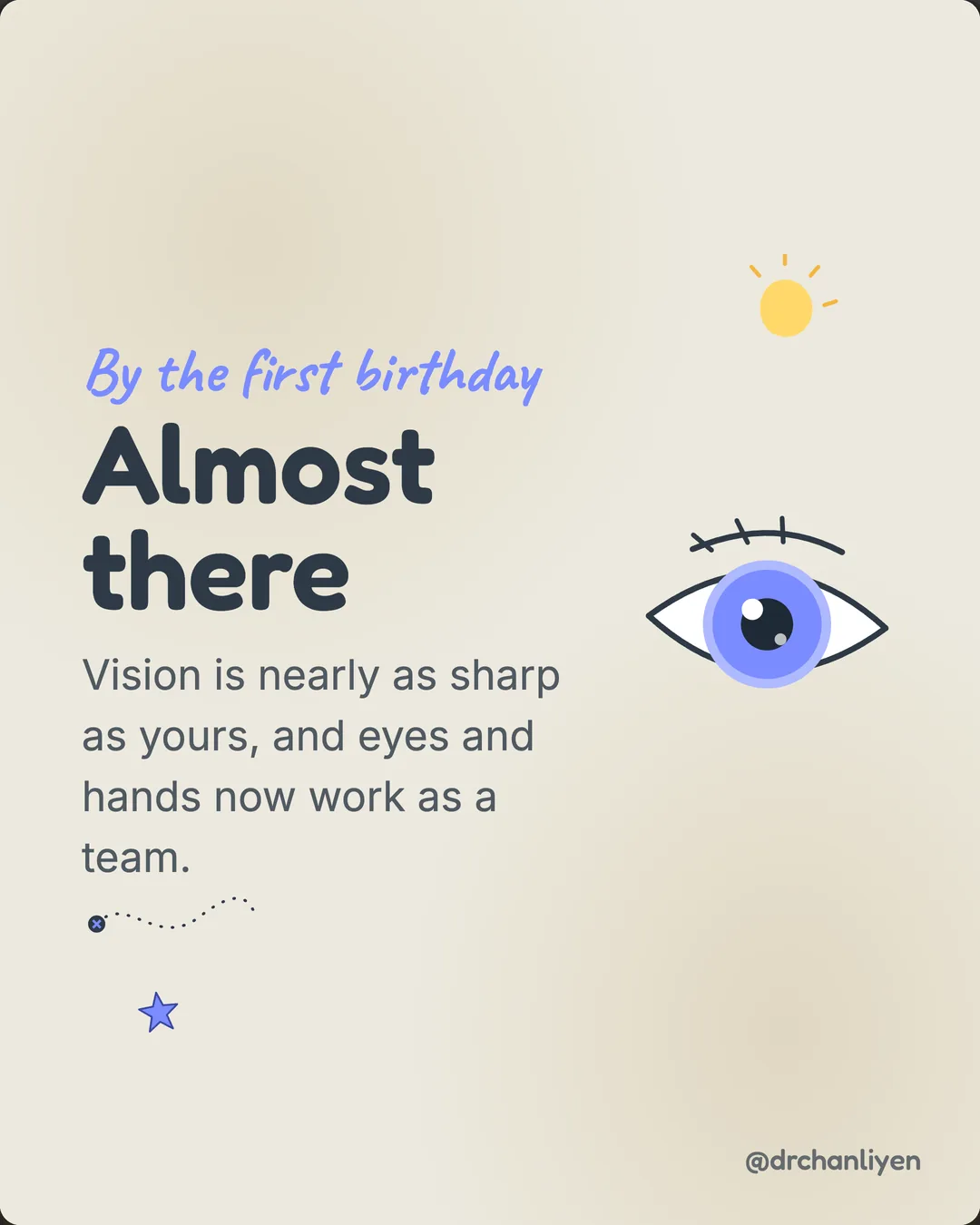
- Vision keeps sharpening for years: adult-level sharpness usually arrives somewhere between three and five years old.
- A white glow in a flash photo, or an eye that never follows, is worth an early check rather than a wait. By around three to four months the eyes should be steady, and NHS advice is to get a squint checked after three months.
Parents often tell me, slightly embarrassed, that they assumed a newborn's eyes barely worked at all. They don't say it that bluntly, but the idea sits underneath a lot of questions in my clinic: can she even see me yet? She can. Just not the way you'd expect, and not at the distance you'd expect either.
When can babies see? From the day they are born, though only close up at first, and then a little further and a little sharper with every month that passes. What follows is the ordinary, unhurried pace of a baby's first year of sight. No deadlines, no pass or fail. Just what tends to happen, roughly when, and the small things worth a smile.
How far can a newborn baby actually see?
Further than most parents expect, but only in outline. A newborn can see across a room from birth, though they are far more interested in what is close to them. What is sharp is much nearer: about 20 to 30 centimetres, almost exactly the distance from your face to your baby's when you feed them.
That is not a limitation to feel sorry about. It is the one distance a newborn is built to see well, because it is the one distance that matters most in the first weeks of life.
Beyond that range, the world is blurred: light, movement, the rough shape of a face, but no fine detail. Newborn sharpness is very low, roughly the largest letter on a chart if a newborn could read one, and it sharpens fast from here. By one year that sharpness, what we call acuity, is closer to 20/200, and it keeps improving for years after that. A newborn is also very sensitive to bright light. The pupils are small at birth too, which limits how much light gets in.
When does a baby first really look at you?
Somewhere in the first month, though it rarely feels like a single moment. At about one month your baby may focus briefly on you, but may still prefer a brightly coloured object up to three feet away. That is not a rejection. Faces and bold patterns are, at this stage, competing for the same small pool of attention, and for a few weeks the bold object often wins.
What changes things is time and proximity, not effort. Hold your baby at feeding distance, let the room be calm, and the fixing on your face tends to arrive on its own. If it hasn't by two to three months, that is worth mentioning at the first eye check rather than something to keep watching alone.
Is it normal for my newborn's eyes to wander?
Yes, in the first few weeks. A newborn's eyes may occasionally wander, cross, or move in a way that looks slightly independent of each other, and that is a normal part of a visual system still coming online, not a fault in it. It should be settling by two to three months.
By around three months, the two eyes should be working together properly: focusing as a pair, and following a slowly moving face or toy smoothly rather than jerkily or separately. Somewhere between twelve and sixteen weeks the two eyes start acting as one coordinated system, what we call binocular vision, and once it starts it arrives fairly quickly.
What I want parents to hold onto is the difference between an occasional wander in the early weeks and a constant turn. An eye that turns in or out all the time, at any age, or a wander that is still there after three months, is the kind of thing I would rather see early. Crossed eyes in newborns carries those thresholds in full, because it is one of the questions I am asked most.
When does a baby start reaching for things they see?
Around three to four months, once eye and hand have started to coordinate. You'll notice it first as a swipe in the general direction of a toy, not yet an accurate grab, and that imprecision is completely expected. It sharpens quickly after this.
Colour is arriving on a similar timeline. By around four months babies are noticeably better at distinguishing colours and shades, and many show extra interest in circular patterns: a bull's-eye, or a spiral. By around five months, colour vision is fairly well developed, though still not quite as fine as an adult's, and this is roughly when your baby starts recognising you from across a room rather than only up close.
If a family history of colour vision differences worries you, that is a separate and much later question, one colour blindness in children answers properly, because it is not something we look for in the first year. How the colour settles over the first year is covered in why a baby's eye colour changes.
When do babies develop depth perception?
More completely by around five months, which is also when the earlier swiping reach starts turning into something more deliberate. Depth and distance judgement keep improving through the rest of the first year. By six months a baby sees the differences between objects and uses that to tell one from another.
Crawling, which usually starts at around eight months, sharpens hand and eye together further still. By around nine months many babies can judge distance well, and by around ten months the reach has become precise enough to pick up something as small as a crumb, using thumb and forefinger together.
That last skill, the pincer grasp, is one of my favourite things to ask parents about, because it tells you a great deal without any equipment at all. A baby who can find and pinch a small piece of food on a highchair tray is using distance, depth, and fine focus together, successfully. It is one of the quiet triumphs of the first year, and it almost always passes unnoticed.
How do I know if my baby's vision is developing normally?
You watch for a handful of ordinary things, not days counted on a calendar. Fixing on and following a face by two to three months. Both eyes working together, with no constant turn, by three months. Reaching for what they see by four months.
Recognising you from across the room by five months. None of these is a deadline. Missing one by a week or two is not, on its own, a reason to worry. If what worries you is whether your baby can see at all, read my baby does not look at me yet.
What I would rather you never wait on is a short list of clearer signals: a white or unusual glow in a flash photo, in one eye or both, which a white glow in photos explains fully; an eye that turns constantly at any age, or a turn that comes and goes and is still there after three months; no fixing or following at all by three months; or your baby objecting strongly whenever one particular eye is covered.
On that turn, two numbers matter: by around three to four months the eyes should be steady, and NHS advice is to get a squint checked after three months.
A watery eye without redness in a baby is usually a blocked tear duct, and about nine in ten of those clear on their own during the first year. It still deserves a look if it does not settle, because a watery eye with light sensitivity, or a cloudy or enlarged eye, is a different problem.
A red or sticky eye in a baby under a month old is different again, and needs to be seen the same day. A yellow tinge at any point in the first year is covered in yellow whites of the eyes in a baby.
Checking is not only for when something looks wrong. It is also one of the more delightful parts of my week: watching a four-month-old track a soft toy across the room for the first time, on cue, both eyes moving together like they have been doing it for years. In a sense, they have been practising all along.
Does a child's vision keep developing after the first year?
Yes, for years. The first twelve months set the foundation, but sharpness keeps refining for years, and adult-level vision typically arrives somewhere between three and five years old. The visual system carries on maturing after that. That long runway is why a squint that seems to come and go is worth checking rather than waiting out: a child can outgrow the look of a wide nasal bridge, but not a true squint.
Sitting very close to a screen is a different thing. It does not damage a child's eyes, though a child who habitually sits very close may be short-sighted, which is worth a look. More for the first year is gathered under newborn eyes (0 to 6 months) and baby eyes (6 to 18 months). For a month-by-month companion, see what your baby can see at 1, 3, 6 and 12 months.
And if a check does turn up something, sometimes a need for glasses, or the kind of assessment described in how we test eyes before a child can read, none of it undoes the year you have just watched unfold. It simply means the foundation gets a little help along the way. Either outcome, the ordinary unfolding or the small intervention, starts from the same place: a baby who has been quietly, remarkably learning to see you back.

- You see a white, pale or "glowing" pupil in a flash photo, in one eye or both.
- One eye turns in or out constantly, at any age, or a turn that comes and goes is still there after three months. By around three to four months the eyes should be steady, and NHS advice is to get a squint checked after three months.
- Your baby does not seem to fix on your face or follow a toy by around three months.
- Your baby objects strongly when one particular eye is covered.
- There is persistent watering, a drooping lid, or an unusual head tilt.
- Your baby is under a month old and has a red or sticky eye. That one needs to be seen the same day.
Common questions
When do newborns start seeing?
How far can a 1 month old see?
When do babies see faces?
When should my baby start following objects with their eyes?
Is it normal for my baby's eyes to wander at a few weeks old?
At what age do babies see colour?
When do babies get depth perception?
When can babies see clearly?
Why does my baby not look at me?
How do I know if my baby's vision is developing normally?
- AAP HealthyChildren · Baby's vision development · www.healthychildren.org
- American Academy of Ophthalmology · Baby vision development, first year · www.aao.org
- American Academy of Ophthalmology · Typical and atypical development of ocular alignment · www.aao.org
- American Academy of Ophthalmology · Common eye and vision myths and facts · www.aao.org
- NHS · Squint (strabismus) · www.nhs.uk
- AAPOS · Nasolacrimal duct obstruction · aapos.org
- NHS · Retinoblastoma symptoms · www.nhs.uk
- NHS · Lazy eye (amblyopia) · www.nhs.uk