How we test eyes before a child can read
No letters, no right answers, nothing to memorise. Here is exactly what happens when we measure the sight of a child who can't yet read, and why most of it feels like a game.

- A child does not need to read, speak, or even cooperate for us to measure their vision accurately.
- Toddlers and preschoolers match pictures or shapes instead of naming letters.
- Retinoscopy, a light and a set of lenses, measures the focusing power of each eye with no answers required at all.
- For babies, we watch how each eye fixes on a target and follows it, and check alignment with a light reflection.
- "Too young to be tested" is a myth, and it is the reason some treatable problems get caught late.
The question I am asked most often, usually in the doorway before we have even sat down, is some version of this: how can you possibly test her eyes when she can't read? It is a fair question. Almost every picture of an eye test that most of us carry in our heads involves a wall chart and a row of shrinking letters. Take the letters away, and it is not obvious what is left.
Quite a lot, as it turns out. Most of what I need to know about a young child's eyes, I can find out without them saying a single word.
Why doesn't an eye test need letters?
Because an eye examination answers three separate questions, and only one of them has anything to do with letters. First: how sharp is the sight in each eye, separately? Second: how does each eye focus? Is it long-sighted, short-sighted, astigmatic? Third: are the two eyes working together as a pair?
The second and third questions do not need the child's cooperation at all. They are measured by observing the eyes themselves. Only the first needs some kind of response, and a response does not have to be a spoken letter. It can be a pointed finger, a matched card, or simply where a baby chooses to look.
How do you test a toddler who can't read the chart?
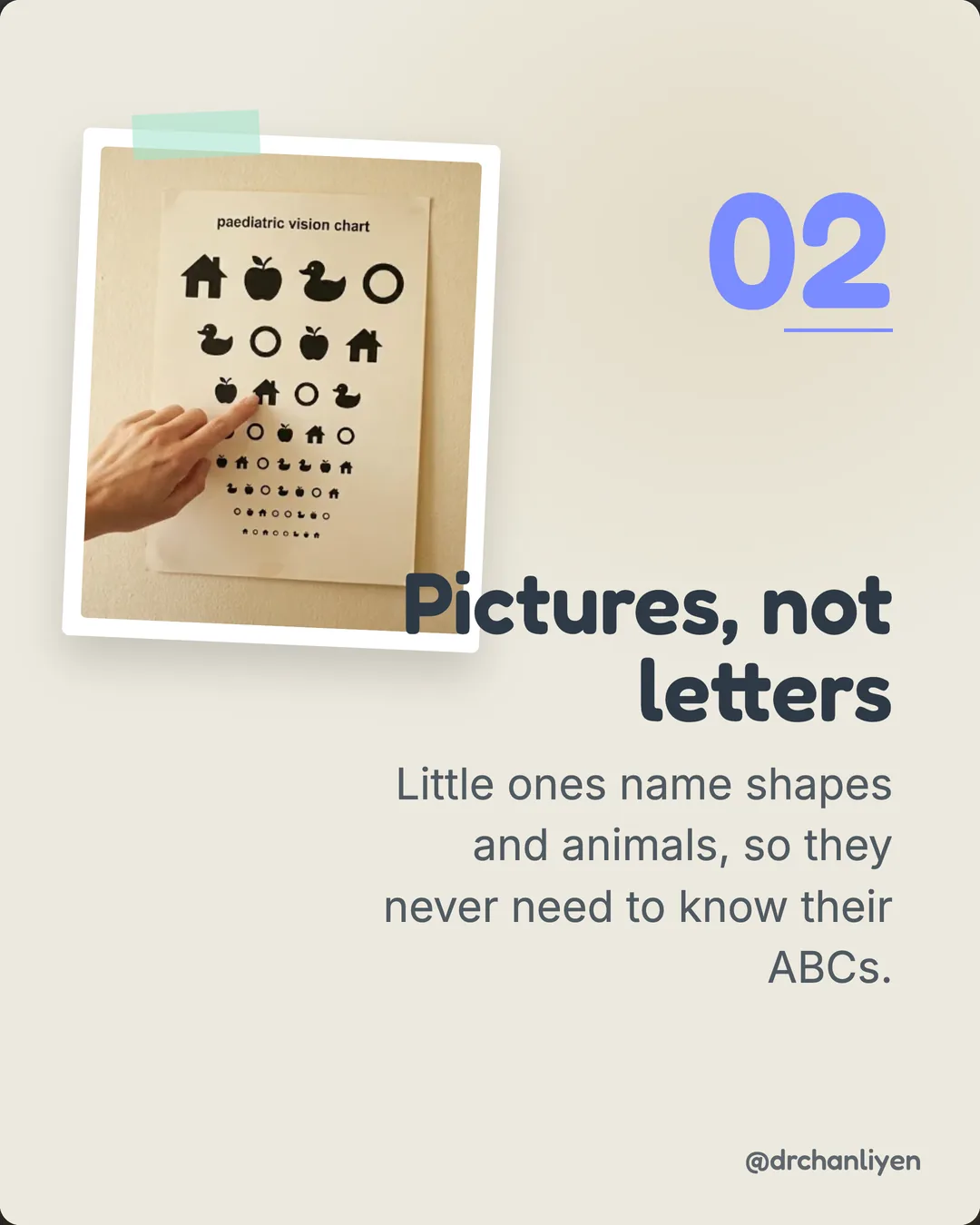
With pictures instead of letters. From about three years old, once a child can match a shape reliably, we swap the letter chart for a symbol chart. The symbols are deliberately simple: a house, an apple, a circle, a square. They are chosen so that they blur in a predictable, measurable way as they get smaller. That last part matters. These are not decorative cartoons. They are calibrated targets that behave the way letters do optically.
Even naming them is not required. We hand your child a card with the same shapes printed large, and ask them to point to the one that matches what we are showing across the room. A shy child who will not speak to a stranger will nearly always point. To them it is a matching game. To me it is a measurement of each eye, one at a time, with the other gently covered.
How can you measure sight with no answers at all?
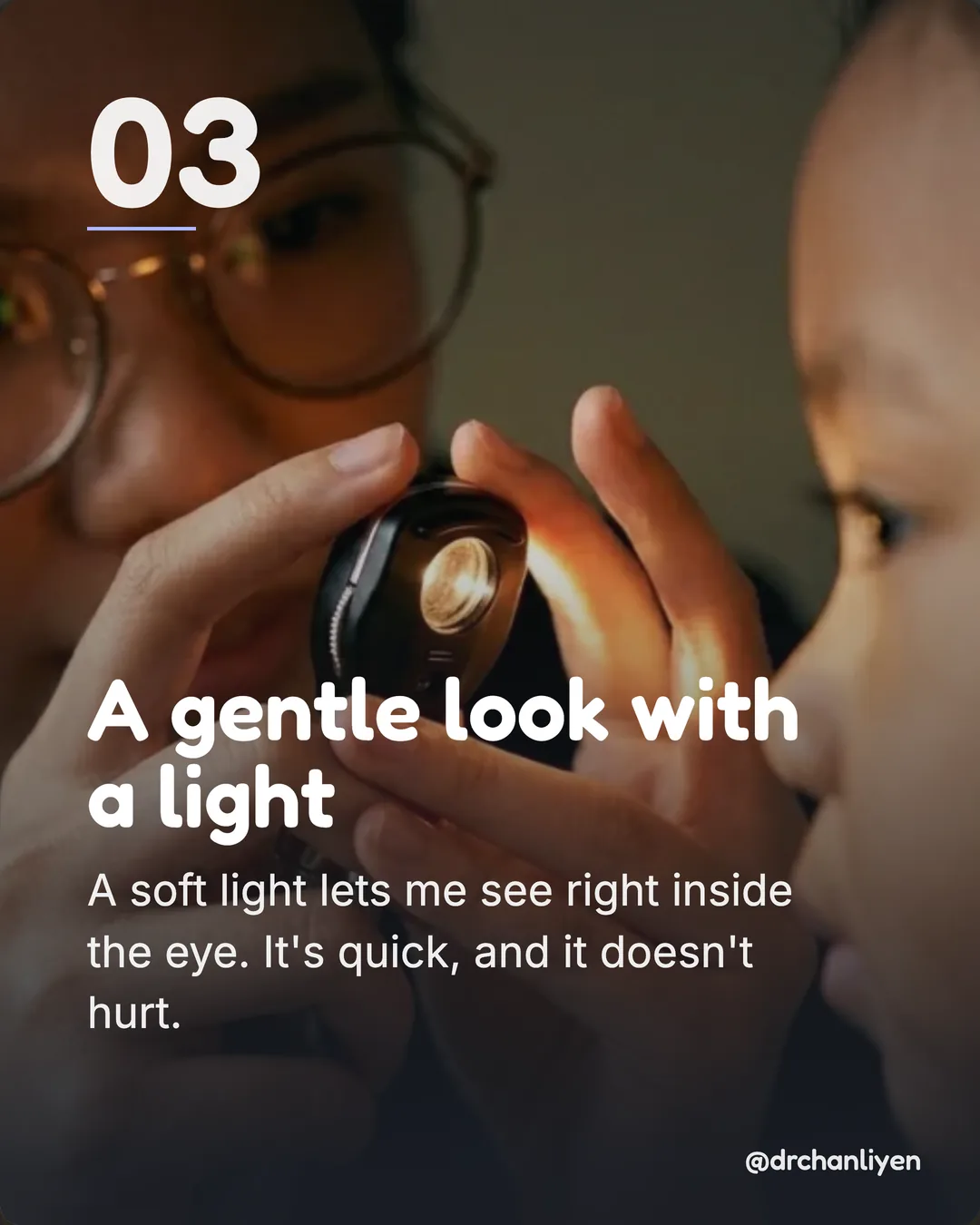
With a light and a set of lenses. This is the part that surprises parents most, and it is the part I would least like to do without. It is called retinoscopy, and it requires nothing from your child except that they sit and look in roughly the right direction.
I shine a streak of light into the eye and watch the reflection that comes back off the retina. As I sweep the light across, that reflection moves, and the direction and speed of that movement tell me whether the eye is focusing in front of, behind, or exactly on the retina. I then hold different lenses in front of the eye until the movement stops. The lens that stops it is, near enough, the child's prescription.
In other words: the measurement comes from the eye itself, not from the child. No opinion is needed from the patient, and there is no "better with one, or two?", which is fortunate, because that question is unanswerable at three years old. A toy or a cartoon keeps your child's attention, and from their point of view a doctor is simply waving a torch about. If the result is a prescription, here is what happens after a child is prescribed glasses.
How do you test a baby who can't even point?
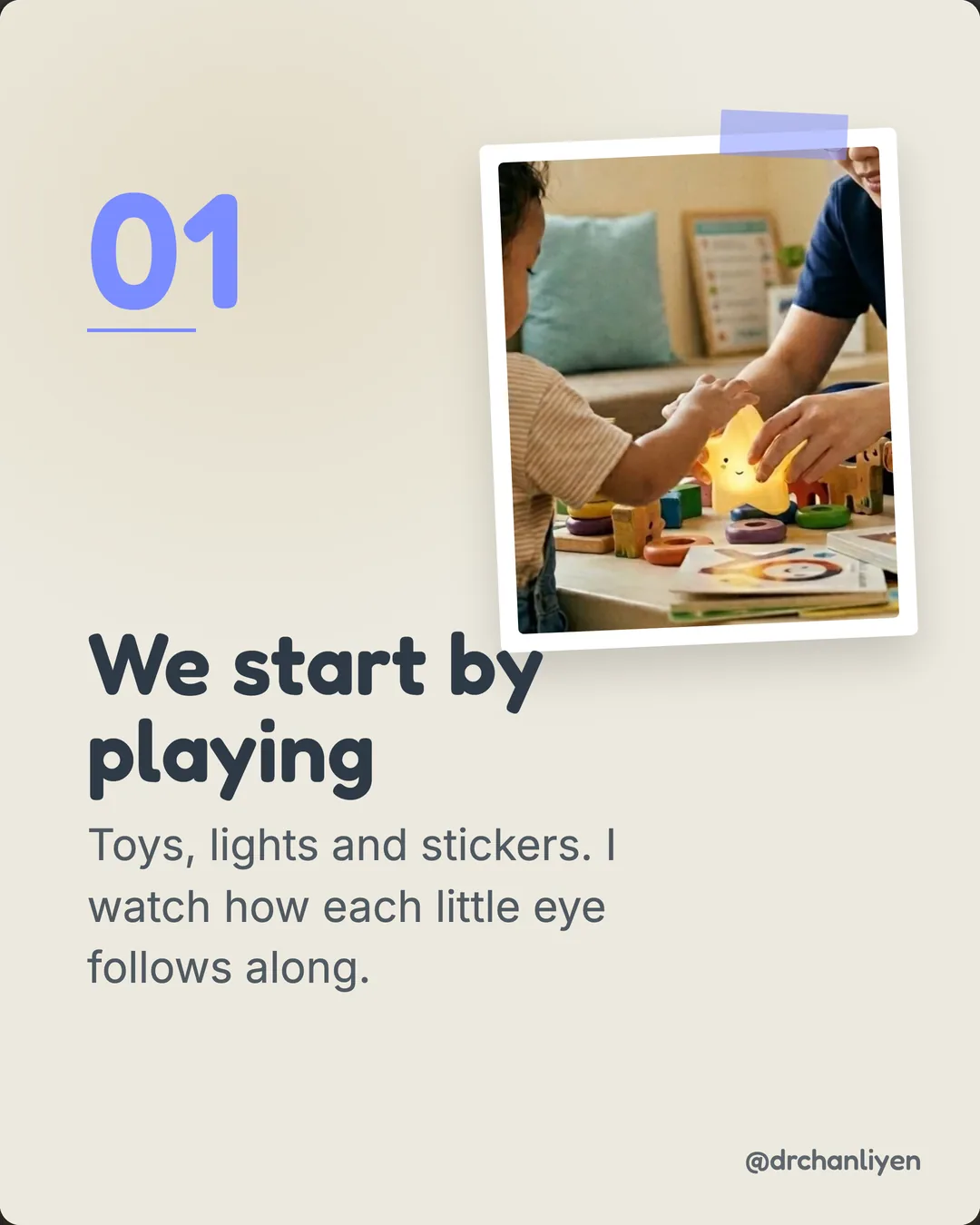
By watching behaviour. Below about a year, we lean on three things. Does each eye fix on something interesting: a face, a small toy, a light? Does it hold that fixation steadily rather than wobbling off? And does it follow when the target moves, smoothly, together with the other eye?
We do this one eye at a time as well as together, because a baby who sees well with one eye and poorly with the other will look completely normal until you cover the good one. That single manoeuvre, covering one eye and watching the reaction, catches a great deal. A baby who is untroubled when you cover the right eye but objects loudly when you cover the left is telling you something important without a word.
Alignment gets checked the same way. A light held in front of the face reflects off both corneas. If those two little reflections sit symmetrically, the eyes are pointing the same way. If one sits off-centre, there is a genuine turn. It is also how we tell a real squint apart from the very common illusion of crossed eyes in a young baby. The timing of these checks matters too, and the schedule for a baby's first eye checks is simpler than most parents expect.
Will my child need dilating drops?
Often, yes, and it is worth knowing why in advance rather than being surprised by it. Children have a very strong focusing reflex. A long-sighted child can compensate so effectively that they measure as normal while quietly straining all day, and that hidden long-sightedness is a common cause of both squint and lazy eye.
The drops relax the focusing muscle so I see the true prescription rather than the one the child is propping up. A dilated pupil also gives me a clear view of the inside of the eye, right to the retina.
The drops sting for a few seconds, and I won't pretend otherwise. After that they make the pupils large and the near vision blurry for some hours, occasionally into the next day. Bright light feels harsh in that time, so bring a hat or sunglasses for the trip home. Allergic reactions to the drops are rare. It is a small, temporary nuisance in exchange for a number we can actually trust.
What will the visit feel like for my child?
Mostly like a slightly odd playdate. Expect a short appointment, longer if we use drops, because they need time to work. Your child stays on your lap if they want to. Nothing touches the eye. There is no pass or fail, and there is no way for them to get it wrong. If they won't play one game, we use another.
The most useful thing you can do is not to over-prepare them. Children who arrive having been told they are going somewhere to have their eyes tested are braced for an ordeal. Children who arrive expecting to look at some pictures with a doctor tend to have an unremarkable, faintly boring appointment, which is exactly what I am aiming for.
Where should I take my child in Malaysia?
Not to the optical shop first, if they are small, though the reason is scope rather than skill. An optometrist is registered with the Malaysian Optical Council under the Optical Act 1991, measures sight, prescribes glasses and contact lenses, and may use Council-approved drops for refraction, so drops are not the dividing line most parents assume.
What a young child also needs is a dilated look at the health of the eye itself, right to the retina and not just its focus, and dilating for a full eye examination is the doctor's part of the work. A reading taken on a four-year-old without drops can look reassuringly normal while missing the very problem you came to rule out.
For a child under school age, or any child where something specific worries you, start with an eye clinic that sees children, or ask your paediatrician or GP to point you to one. Malaysia does check young children's sight before school.
The klinik kesihatan records an eye check at four years old, sight in each eye and a light reflection test for alignment, and the school health team checks sight at preschool and again in Tahun 1. Those school visits reach government and government-aided schools, so a child in a private tadika may be missed.
That is not meant to alarm you. It simply means that if you have noticed something, a white glow in a photo, a drifting eye, a strong objection to covering one eye, the appointment is yours to make, and making it early is nearly always the whole battle. If what you have noticed is one of the signs that should not wait for a routine slot, is this urgent? gives each one a plain answer: today, this week or routine.
And if the visit finds nothing? Then you have learned that your child sees well, and I have had the easiest consultation of my day. I would rather see ten children for nothing than miss one who needed us. That trade is never close.
- You see a white, pale or "glowing" pupil in a photo or in ordinary light.
- One eye turns in or out constantly, or is still wandering past about three to four months of age.
- Your child objects strongly when one particular eye is covered.
- There is a drooping lid, a persistently watery or red eye, or an unusual head tilt.
- Anyone in the family had a squint or a lazy eye as a child.
Common questions
What age can a child first have their eyes properly tested?
What if my child won't cooperate at all?
Is the school vision screening in Malaysia enough?
Do the dilating drops hurt, and how long do they last?
Can a toddler really be prescribed glasses?
How often should my child's eyes be checked?
Do I need a referral to see a paediatric eye doctor?
- American Academy of Ophthalmology · Eye screening for children · www.aao.org
- American Academy of Ophthalmology · Vision screening for infants and children, clinical statement 2022 · www.aao.org
- American Academy of Ophthalmology · Procedures for the evaluation of the visual system · www.aao.org
- AAPOS · Dilating eye drops · aapos.org
- AAPOS · Amblyopia (lazy eye) · aapos.org
- AAPOS · Pseudostrabismus (the corneal light reflex and cover tests) · aapos.org
- Optical Act 1991 (Act 469), reprint incorporating amendments to 31 December 2001 · worldcouncilofoptometry.info
- Kementerian Kesihatan Malaysia · Rekod Kesihatan Bayi dan Kanak-kanak 0 to 6 tahun, Pindaan 03/2021 (the four-year eye check) · hq.moh.gov.my
- MyGovernment · Kesihatan Sekolah untuk Murid Pra-Sekolah · www.malaysia.gov.my