Cross eyed baby: what is normal, and when to have it checked
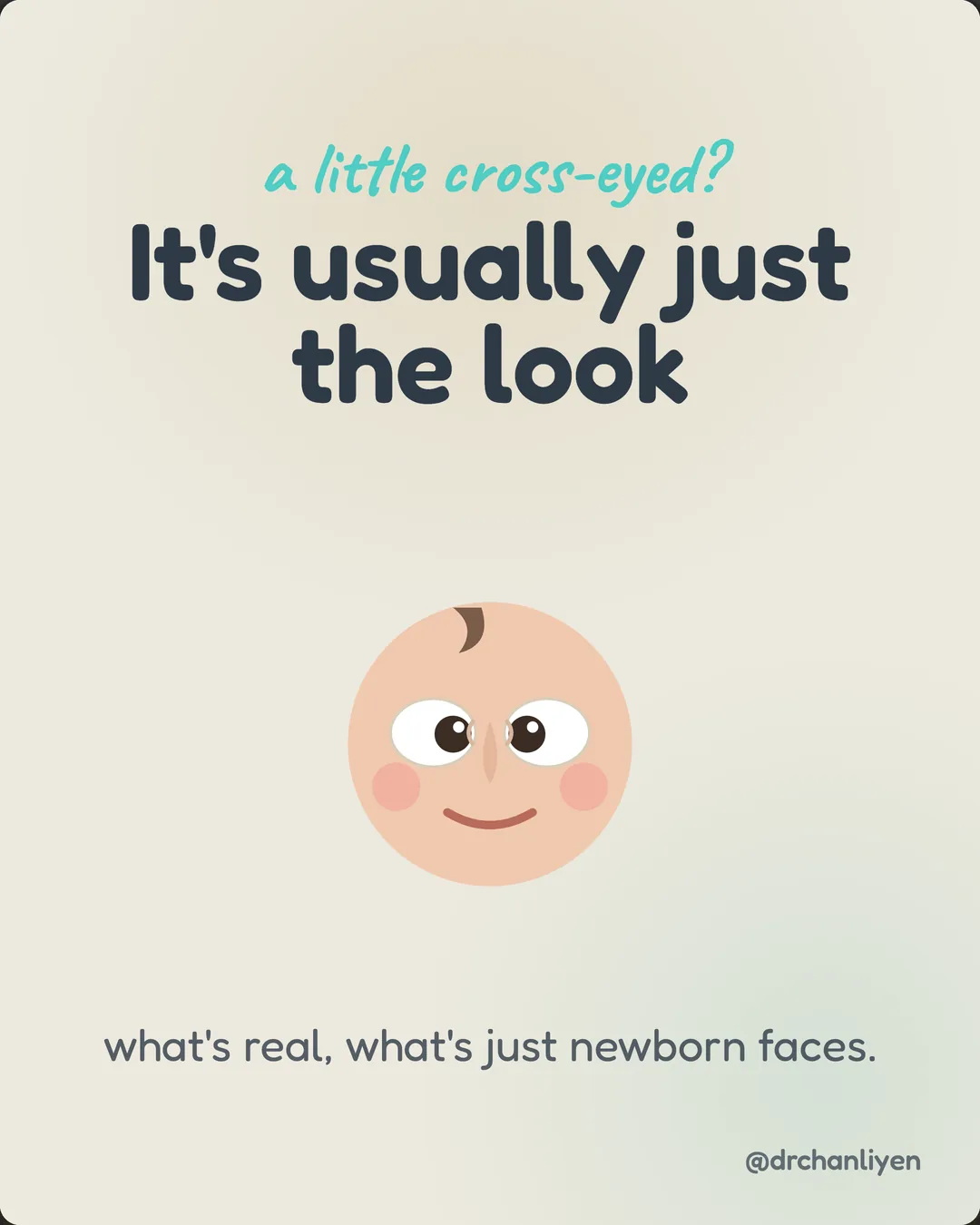
You caught your newborn's eyes crossing and your stomach dropped. Most of the time, that is what a young visual system looks like while it is still learning to work as a pair.

- A cross eyed baby in the first weeks is usually normal, because the two eyes are still learning to aim at the same spot.
- By around three months the eyes should be focusing and tracking together, and the random wandering should be going.
- An eye that turns constantly, at any age, is checked rather than watched.
- A turn that still comes and goes past three to four months should also be checked. The NHS line is after three months, the AAPOS line is beyond four, so treat it as a window rather than a single date.
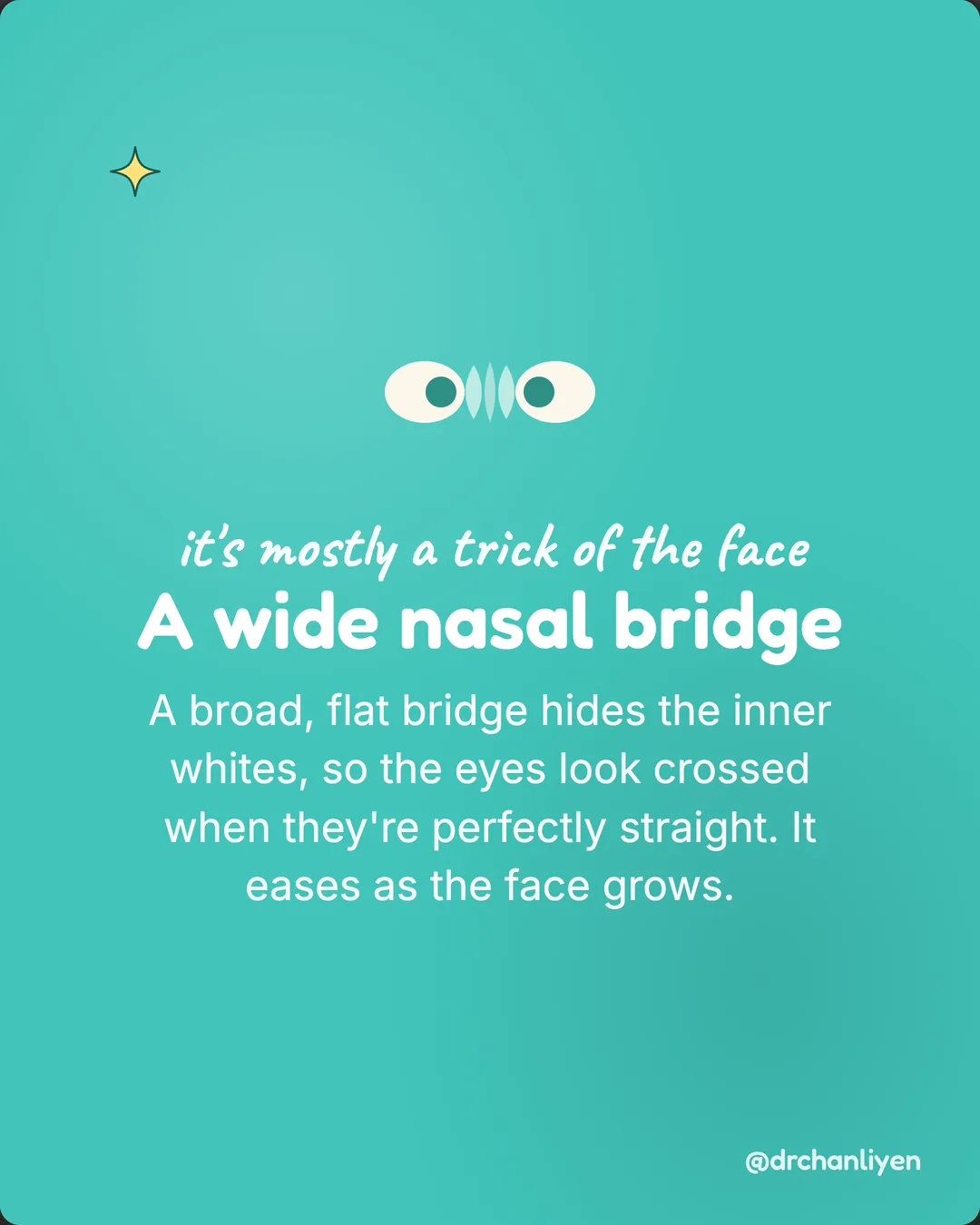
- A wide nasal bridge and skin folds at the inner corners can make straight eyes look crossed. That illusion is called pseudostrabismus, and only an examination separates it from a real turn.
Age changes the answer here more than anything you can see in your baby's face. A cross eyed baby at three weeks and a cross eyed baby at eight months are two different conversations. In the first weeks, eyes that cross or drift now and then are usually a young visual system still learning to aim both eyes at one spot. By around the fourth month that learning is usually finished. Here is how I sort the ordinary from the rest, month by month.
Is it normal for newborns to cross their eyes?
Yes, in the early weeks it usually is. A newborn's eyes can cross, drift outwards or move randomly while the skill of pointing both eyes at the same spot is still being built. The NHS puts the line plainly: in babies younger than three months, squints that come and go are common and not usually a cause for concern.
Your baby is born with two eyes that see. What is not yet built is the coordination, what we call eye teaming, that keeps them aimed at the same spot. It is rehearsed in the weeks after birth, and while it is under construction the eyes wander now and then. Two studies reviewed by the Academy of Ophthalmology give the scale of it.
One found seven in ten infants showed an outward drift at some time. The other found eight in a hundred had eyes misaligned for more than fifteen percent of their waking hours. Parents notice inward drifts far more than outward ones, which is why the word you reach for is crossed.
A baby who crosses now and then and looks straight the rest of the day is the ordinary version, and it is one of the questions I am asked most at a baby's first eye check.
When do babies stop going cross eyed?
For most babies, somewhere between three and four months. The random movement should be going away by two to three months, and at three months a baby's eyes should be working together to focus on and track an object. Adult-like binocular vision, the two eyes acting as one, emerges between twelve and sixteen weeks.
I give parents two numbers, because the sources genuinely differ and you should have both. The NHS says get advice if your child is older than three months and has a squint that comes and goes. The alignment literature says newborn misalignments are less frequent by two months and, in typical children, gone by four, with the third month as the tipping point.
AAPOS says any eye crossing beyond four months, constant or not, should be checked out. There is no single magic date in there. Through the third month you watch the drifting quieten. If it has not quietened in the fourth, book.
What does a cross eyed baby mean at 2 months, 4 months and 8 months?
The age changes the answer completely. At two months, crossing that comes and goes is ordinary. By four months it should have finished, so crossing that is still there earns a check. At eight months there is no developmental explanation left to wait for.
- Newborn to 2 months. The eyes cross, drift out or move randomly now and then. A 2 month old baby crossing eyes on and off, and straight the rest of the time, sits inside the normal pattern.
- 3 months. The turning point. The eyes should be focusing and tracking together, and the wandering should be settling rather than staying as it was. The NHS advice starts here: get advice if your child is older than three months and has a squint that comes and goes.
- 4 months. A 4 month old cross eyed at all, on and off or all the time, should be seen. This is not an emergency. It is an appointment.
- 5 months and beyond. A cross eyed baby at 8 months is past every developmental explanation. Book the check, whatever anyone tells you about waiting.
One rule cuts across the whole ladder: a turn that is there constantly, at any age, newborns included, gets checked rather than watched.
Why does my baby look cross eyed in photos when the doctor says the eyes are straight?
Because of the shape of her face, not the aim of her eyes. This is pseudostrabismus, where the eyes look as though they are not straight but actually are. The cause is a wide, flat nasal bridge and small folds of skin at the inner corners, called epicanthal folds.
It is very common in babies, and most grow out of it on their own. It shows up most in photographs and when your baby glances sideways, which is why your camera roll is full of it. I cannot tell pseudostrabismus from a true turn by looking at a photograph, and neither can you.
I shine a light at both eyes and check that the reflection sits in the centre of each pupil at the same time, then cover each eye in turn and watch for movement. Those two tests, the corneal light reflex and the cover test, separate the illusion from the real thing.
Does one reassuring check settle it for good?
Not quite, and this is the one caveat I want every parent to hear. A reassuring visit tells you that today, your baby's eyes are aligned. It is not a permanent all clear. A baby with pseudostrabismus can still develop a true squint later. So the rule is not "checked once, never think about it again", it is "checked once, and keep noticing", which is the ordinary looking you already do at bath time.
Will my baby grow out of a squint?
No. A true squint, where one eye consistently points somewhere different from the other, is unlikely to get better on its own. A child can outgrow pseudostrabismus but not strabismus, which is the clinical way of saying that the illusion fades and the real thing does not.
The reason I press on this is not how the eyes look. When the two eyes point in different directions, the brain receives two different pictures and may start ignoring the one from the misaligned eye to avoid seeing double. The sight in that ignored eye then develops poorly.
That is a lazy eye, and vision lost that way can be permanent if it is not treated at a young age. The NHS also notes that a squint can sometimes be a symptom of retinoblastoma, a rare childhood eye cancer. That is one more reason a constant turn gets examined rather than watched.
None of that means an operation. Treatment may involve glasses, eye exercises, prisms, or eye muscle surgery, depending on the type and the cause. Where a child is more long-sighted than usual, the eyes cross from the effort of over-focusing to see clearly. Glasses reduce that effort and help straighten the eyes, and surgery is only considered if glasses do not fully straighten them.
What should I do if my baby's eyes are not aligned?
Book a check, and bring the photographs you already have. Eyes that are not aligned constantly, at any age, or a turn that comes and goes past three to four months, is an appointment rather than more waiting. What a drift looks like at home goes through what to look for in them.
Two other NHS-listed signs are worth mentioning at that visit: a baby who regularly turns their head to one side, or keeps one eye closed. Say as well if a squint or a lazy eye runs in your family, because squints sometimes do.
How babies learn to see walks through the same timeline from birth, which makes all of this easier to read calmly. Your baby does not have to name a letter or say a word for any of it, and how we test children's eyes sets out what is done instead. If the turn appeared suddenly in eyes that were straight before, is this urgent? answers it plainly: today, this week or routine.
I am asked the newborn version of this nearly every week. The visit itself is short: a light, a cover test, and then one of two answers. Either the eyes are straight and the look comes from the shape of her face, or there is a real turn to work on. Either answer is worth more than another month of wondering.
- One eye turns in or out constantly, at any age.
- A turn that comes and goes is still happening past about three to four months.
- Your baby regularly turns their head to one side or keeps one eye closed.
- An eye that was straight before starts turning suddenly.
Common questions
Why do babies go cross eyed?
Is transient strabismus normal in newborns?
Are babies born cross eyed?
Does a baby go cross eyed sometimes?
Is it normal for a baby to be cross eyed at 2 months?
My 2 month old baby is crossing eyes, is that normal?
My 4 month old is cross eyed, what should I do?
My cross eyed baby is 8 months old, is it too late to have it checked?
My baby goes cross eyed sometimes but not all the time, does that matter?
What is pseudostrabismus and does it go away?
Will my baby grow out of a squint?
Baby's one eye turns inward when tired, is that ok?
Does a squint in a baby need surgery?
- NHS · Squint · www.nhs.uk
- American Academy of Ophthalmology · Baby's vision development in the first year · www.aao.org
- American Academy of Ophthalmology · Typical and atypical development of ocular alignment · www.aao.org
- American Academy of Ophthalmology · Strabismus in children · www.aao.org
- AAPOS · Pseudostrabismus · aapos.org
- AAPOS · Strabismus · aapos.org
- AAPOS · Esotropia · aapos.org
- American Academy of Pediatrics, HealthyChildren · Baby's vision development · www.healthychildren.org
- AAPOS · Accommodative esotropia · aapos.org