Lazy eye: how to spot the drift early
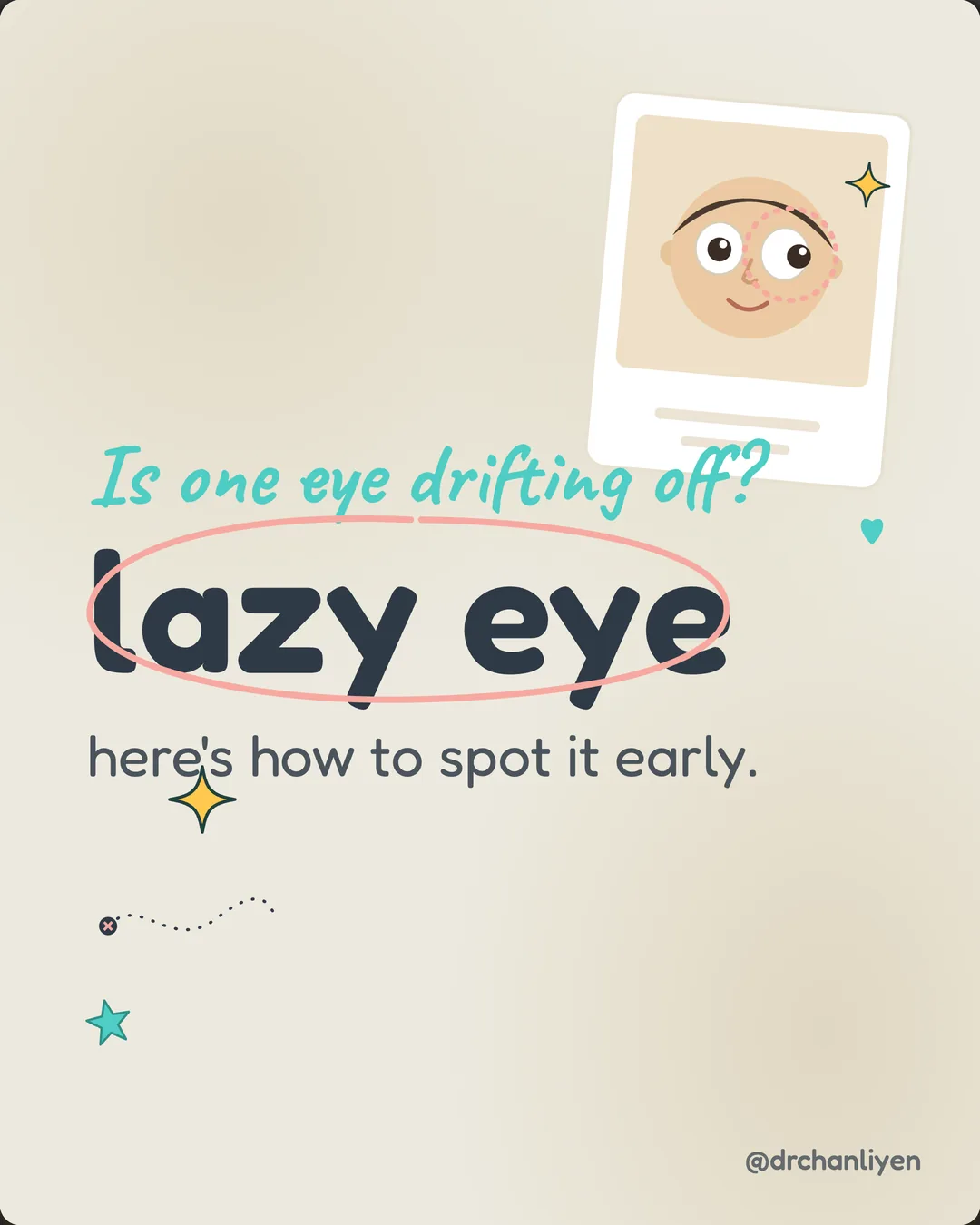
One eye turns, or the two never quite line up in a photo. Your child insists nothing is wrong, because to them nothing is. What the drift looks like, and why catching it early makes treatment so much easier.

- A lazy eye (amblyopia) is a problem with how the brain uses an eye, not just a problem with the eye itself, and glasses alone do not always fix it.
- A squint (a visible turn) and a lazy eye (reduced vision) are not the same thing, though one often causes the other.
- Your child will never complain, because they have never known any different. You are the one who has to notice.
- Treatment is easiest before school age, but it is not hopeless afterwards. Older children can still gain real vision with treatment.
- Patching and atropine eye drops work about equally well for moderate amblyopia, so there is usually a choice that suits your family.
Almost every week, a parent brings me a photo on their phone before we have even said hello properly. Doctor, look, is this eye turning? Sometimes it is. Sometimes it is nothing at all, a trick of the angle or the flash. What I cannot tell from a photo alone, and what worries me more than the turn itself, is the thing you cannot see: whether that eye is actually being used.
That is what a lazy eye is. Not a look. A loss.
What is a lazy eye, really?
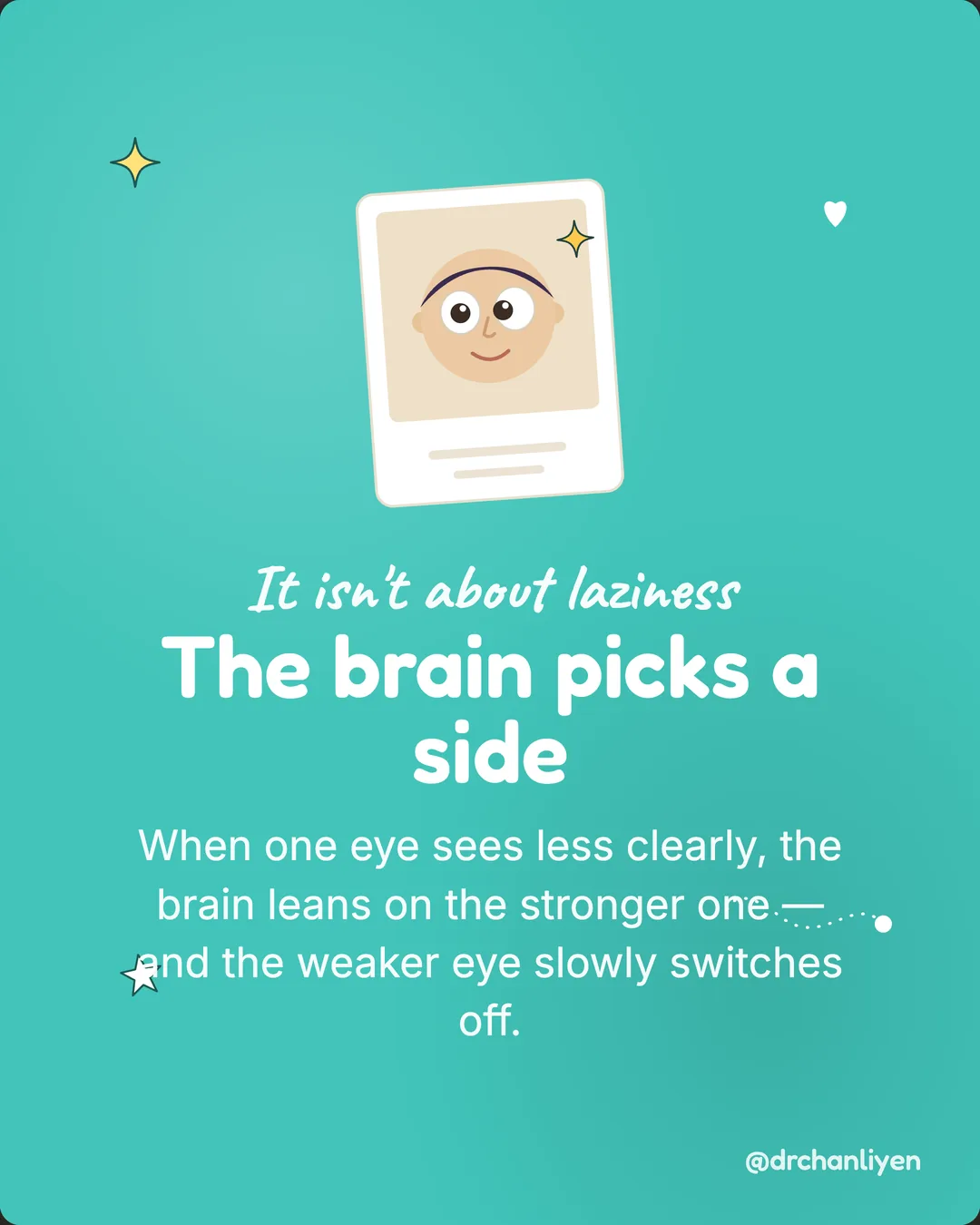
A lazy eye, what we call amblyopia, is reduced vision in an eye that has nothing wrong with its structure. The eye itself can be perfectly healthy. The problem sits further back, in how the brain has learned to use it.
If one eye sends a blurrier or more mismatched picture than the other during early childhood, the brain quietly starts to prefer the clearer eye and switches the weaker one off, the way you might stop listening to a radio station that is mostly static. The eye does not get worse on its own. The brain simply stops asking it to work.
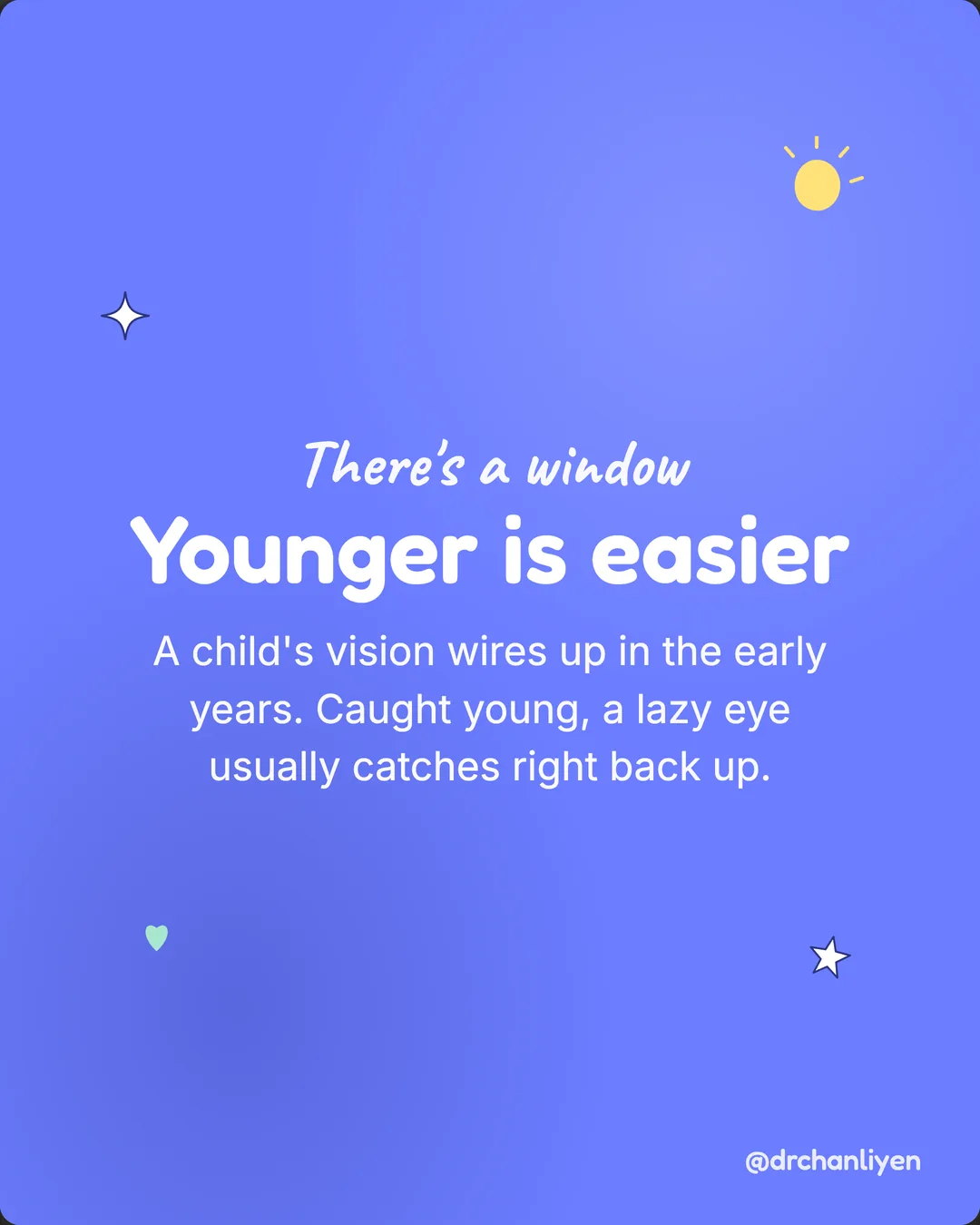
This matters because it changes what treatment has to do. We are not only correcting an eye, we are retraining a preference the brain has already formed, and that works far better while a child's visual system is still developing. Amblyopia is the leading cause of reduced vision in children, and also one of the most treatable, while it is caught early.
Is a squint the same thing as a lazy eye?
No, and I spend a good part of most consultations untangling this. A squint, or strabismus, what many Malaysian families call mata juling, is a visible turn, one eye pointing somewhere different from the other, and you can see it from across the room. A lazy eye is invisible. It is a measurement of how well an eye sees, not how it looks, and an eye can be lazy while pointing perfectly straight.
The two are close cousins because a squint is one of the commonest causes of a lazy eye: if one eye is consistently turned, the brain stops using its signal, and that eye becomes lazy on top of being turned.
But you can have a squint without a lazy eye if it is caught early, and you can have a lazy eye with two eyes that look perfectly aligned, usually because one eye has a much stronger prescription than the other and nobody noticed. This is exactly what a proper eye test is designed to catch, because a parent watching a child play cannot see an unequal prescription, only a doctor measuring each eye separately can.
There is a third route in babies: anything that physically blocks or presses on one eye while the vision is still forming, and a raised red lump growing on an upper eyelid in the first months is one of those. Dr Ong Jin Khang, who practises skin medicine at The Retreat Clinic, prescribes nothing for children and has no laser suited to one, and he sets out why an eyelid haemangioma is judged on timing and position rather than on size.
Why does my child never complain about it?
Because your child has never seen any other way. A lazy eye develops gradually, in a child too young to describe what "normal" vision should look like, so there is no before to compare it to and nothing that feels like a loss. An adult who suddenly lost vision in one eye would tell you immediately. A three-year-old who has always seen poorly out of one eye assumes that is simply how eyes work.
This is the hardest thing for parents to accept, and I say it gently every time: the absence of complaint tells you nothing. Your child is not hiding a problem from you. They genuinely do not know one exists. The job of noticing falls entirely on the adults around them, which is uncomfortable, but it is also good news, because it means the problem is there to be found well before school age.
What does the drift look like at home?
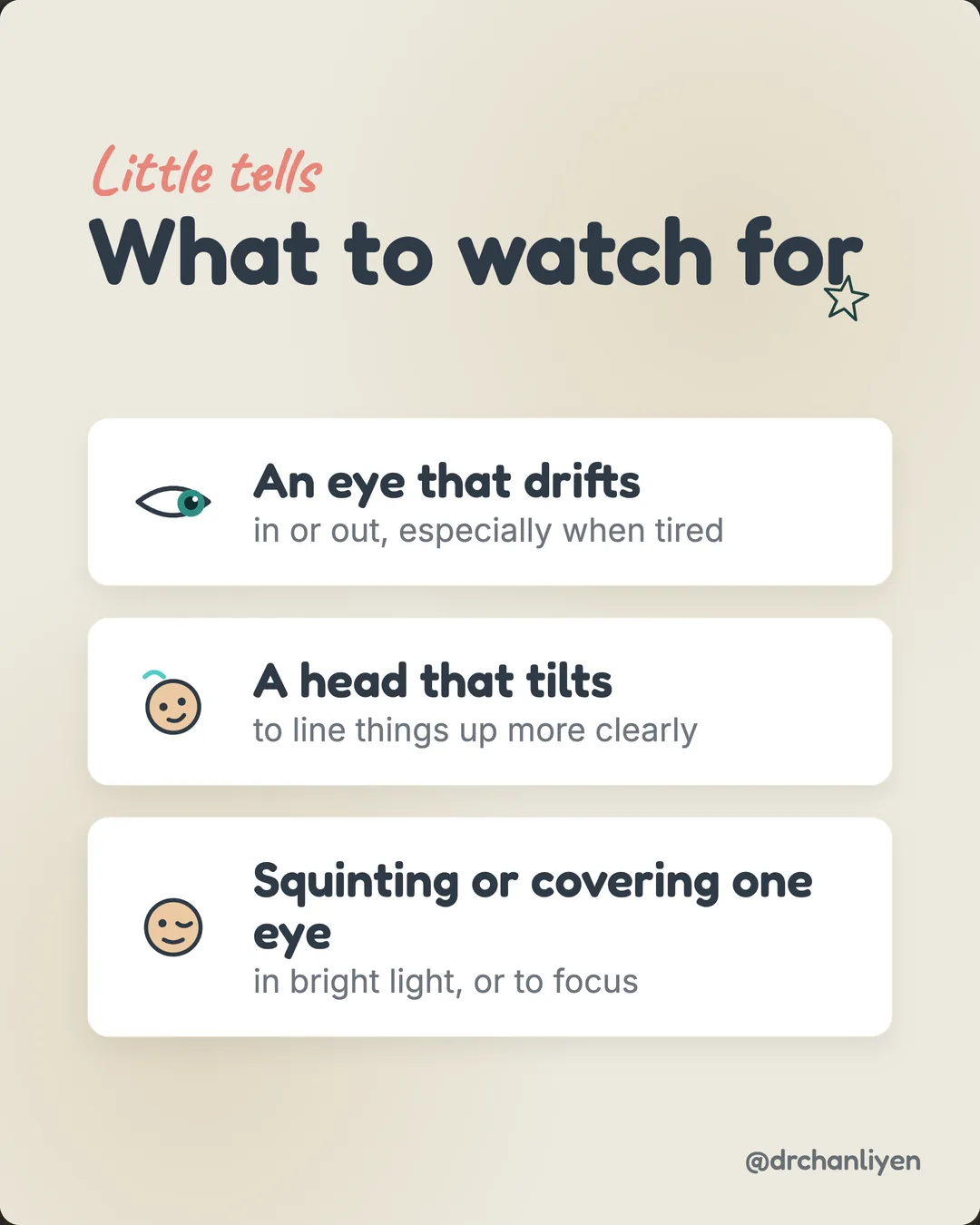
Usually it shows up in small, easy-to-dismiss moments. An eye that turns in or out when your child is tired, unwell, or concentrating hard on something close, then seems to straighten the rest of the time. A head that tilts to bring things into focus. A child who bumps into things on one side, or misjudges a reach for a cup.
Photographs are often the most honest witness in the house, because a camera catches a single frozen instant that a moving, blinking child does not give you in real life. If one eye in your photos consistently looks like it is pointing somewhere different, even when everything looks fine in person, that pattern is worth trusting. A related warning sign to know is a white glow in a photographed pupil, checked with the same urgency though it is a different thing.
The other test I teach parents is the cover test, and you can do a rough version of it yourself. Cover one eye gently with your hand and watch your child's reaction. A child who is untroubled has nothing to hide.
A child who protests loudly, tries to pull your hand away, or becomes visibly distressed the moment their better eye is covered is telling you, without a single word, that the other eye is not carrying its share. How far a home check can go, and where apps fall short, is in checking your child's eyes at home.
Could it just be her nose bridge?
Quite often, yes, and this is worth knowing before you frighten yourself. Many babies, especially many Asian babies, have a wide, flat nasal bridge with a fold of skin at the inner corner of the eye. That extra skin hides more of the white of the eye on one side than the other, and from certain angles, particularly side on, it creates a very convincing illusion that one eye is turning inward when it is not. This is called pseudo-squint, common and harmless.
The way to tell a true turn from this illusion is not to stare harder at the photo. It is a light reflection test, which takes a doctor a few seconds: a light is held in front of the face, and if the tiny reflection sits in the same spot on both corneas, the eyes are pointing the same way regardless of how much white shows on each side.
A real, steady turn is different at any age, and one still coming and going past about three to four months should also be seen. If you are unsure which one you are looking at, that uncertainty is itself the reason to book the check.
How is a lazy eye treated?
Glasses first, almost always. If the lazy eye is caused by an unequal or uncorrected prescription, simply giving the eye a clear image can improve it on its own, and wearing the right glasses does not weaken a child's eyes, whatever the family aunty may have said. If a squint is caused by a child straining to focus, glasses sometimes straighten the eyes as a side effect, by removing the need to overwork the focusing muscle.
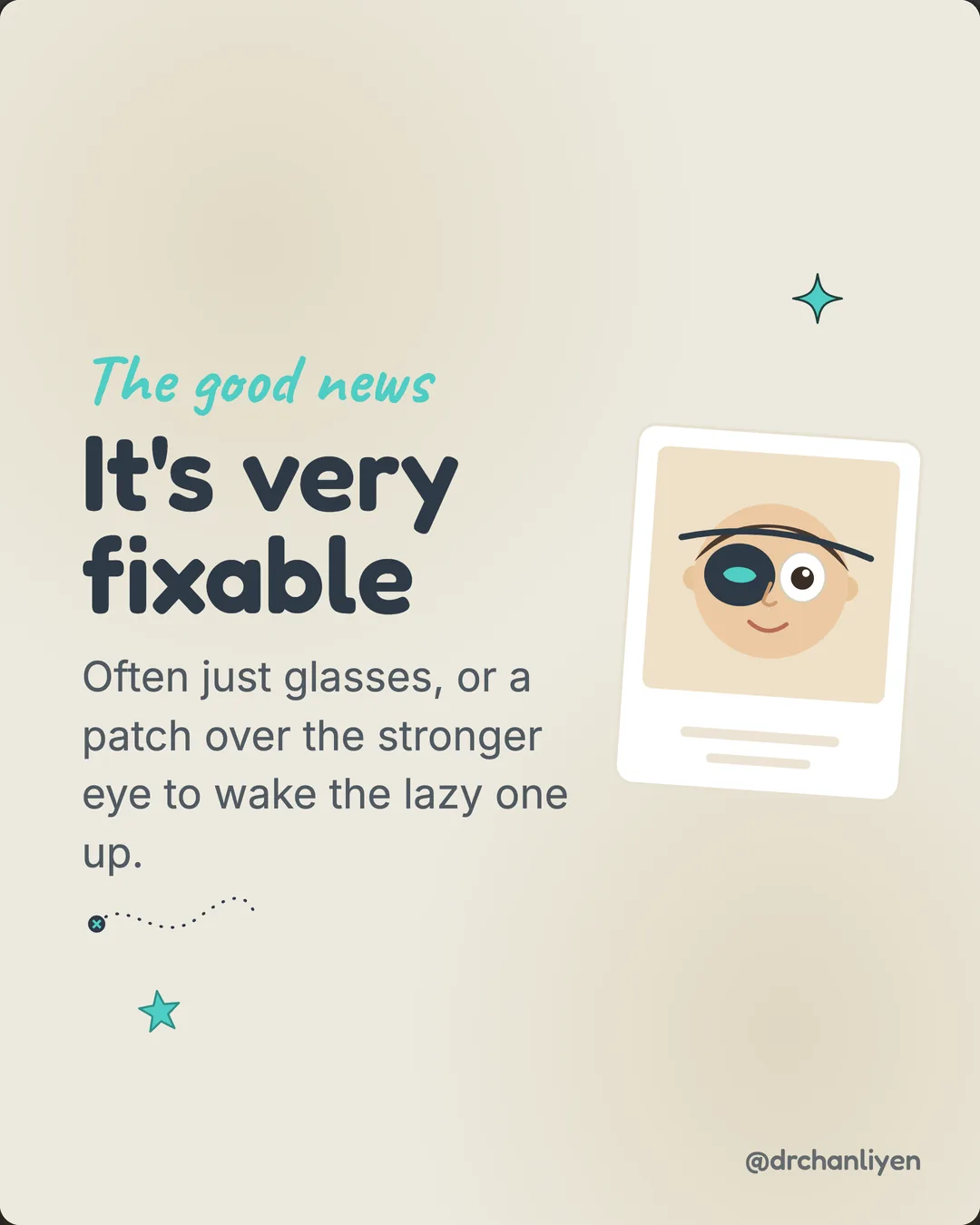
If glasses are not enough alone, we ask the stronger eye to step back so the weaker eye is forced to work. That means either patching, physically covering the good eye for part of the day, or atropine drops, which blur the good eye instead of covering it.
Parents often assume patching must be the stronger option because it is more visible, but the research does not bear that out. A major trial comparing the two for moderate amblyopia found atropine worked about as well as patching, and many families find drops easier to live with. There is usually a genuine choice, not one correct answer.
And patching life, since you will wonder? Hard, some days. I will not pretend otherwise, because a parent who has just spent a morning peeling a patch off the kitchen floor does not need to hear that it is simple. Covering a child's better eye makes their world blurrier for those hours, and plenty of children object loudly. Missed days happen. Meltdowns happen. Neither means you are failing.
What helps, in my experience, is treating the patched hours as their own small ritual: a favourite activity saved specifically for patch time, a sticker chart, a patch with a design your child chose. If an approach genuinely is not working after a real trial, say so at your next visit rather than gritting through in silence. Switching to drops or adjusting the hours is always on the table, and there is no prize for suffering through the harder option when an equally effective one exists.
When should I actually bring her in?
Do not wait for a routine check-up if you have noticed a turn that persists past about three to four months of age, a child who resists having one eye covered, a turn that comes and goes with tiredness, or a family history of squint or lazy eye.
One situation deserves its own sentence: a squint that appears suddenly in an older child who never had one, especially alongside double vision, a new head tilt, or a child who seems unwell, should be seen promptly, within days rather than weeks, and it is worth using the word "sudden" when you phone. More often than not there is a manageable explanation, and a sudden change is precisely the kind of thing an eye doctor wants to look at quickly rather than watch from a distance.
School vision screening in Malaysia generally starts in primary school, which leaves the years when amblyopia is easiest to treat sitting in parents' hands rather than a system's. So the booking falls to you, and the earlier years are the valuable ones.
There is a third possibility, and it belongs to adults rather than children. In childhood the problem is nearly always control: the muscles work, the aiming does not. A turn or double vision arriving new in adult life more often means a muscle that has become physically restricted, by thyroid eye disease or by an old injury to the bones around the eye.
My colleague Dr Catherine Chow, a consultant oculoplastic surgeon, sets out when double vision in an adult is not a squint at all. If your own eyes brought you here, start with hers. A squint carried since childhood, or one that has come back, can still be treated, and I see parents and grandparents too, as part of eye checks for the whole family.
The reassuring part, and I mean this honestly, is that this is one of the most treatable problems that comes through my door, and treatment does not stop being worthwhile the day a child turns eight. Easiest early, still worth treating later, for as long as your child is growing.
If something about your child's eyes has been nagging at you while reading this, that nagging is the only signal you need to book the check. And if the drift arrived suddenly, or your child is seeing double, that moves from booking to being seen this week or today.
- One eye turns in or out constantly, or is still doing it past about three to four months of age.
- Your child objects strongly, cries, or pulls away when you cover one particular eye.
- The turn comes and goes, especially when your child is tired, unwell, or staring hard at something close.
- One eye consistently looks different from the other in photographs, even if it looks straight in person.
- A parent, sibling, or grandparent had a squint or a lazy eye as a child.
Common questions
Will she just grow out of it?
Is lazy eye the same thing as a squint?
My baby looks cross-eyed, but is it just her nose bridge?
Is patching cruel? My child hates the patch and fights me every day.
How long does patching go on for, and is there an alternative to the patch?
Is it too late to fix a lazy eye at 7, 8, or 10?
Will he need surgery, or can glasses fix it?
If we do nothing, will he actually lose the sight in that eye?
I had a lazy eye as a child. Will my children get it too?
- AAPOS · Amblyopia (lazy eye) · aapos.org
- American Academy of Ophthalmology · Amblyopia (lazy eye) · www.aao.org
- American Academy of Ophthalmology · PEDIG studies on the quality of amblyopia treatment · www.aao.org
- AAPOS · Accommodative esotropia · aapos.org
- AAPOS · Glasses for children · aapos.org