Colour blindness in children: how we test for it
Usually not "everything is grey", and not something you did. How we test a child's colour vision, why it runs in families the way it does, and what a result changes in an ordinary school day.

- Most people who are colour blind see partial colour, not a grey world. The usual pattern is confusing shades of red and green, and everything else looks normal.
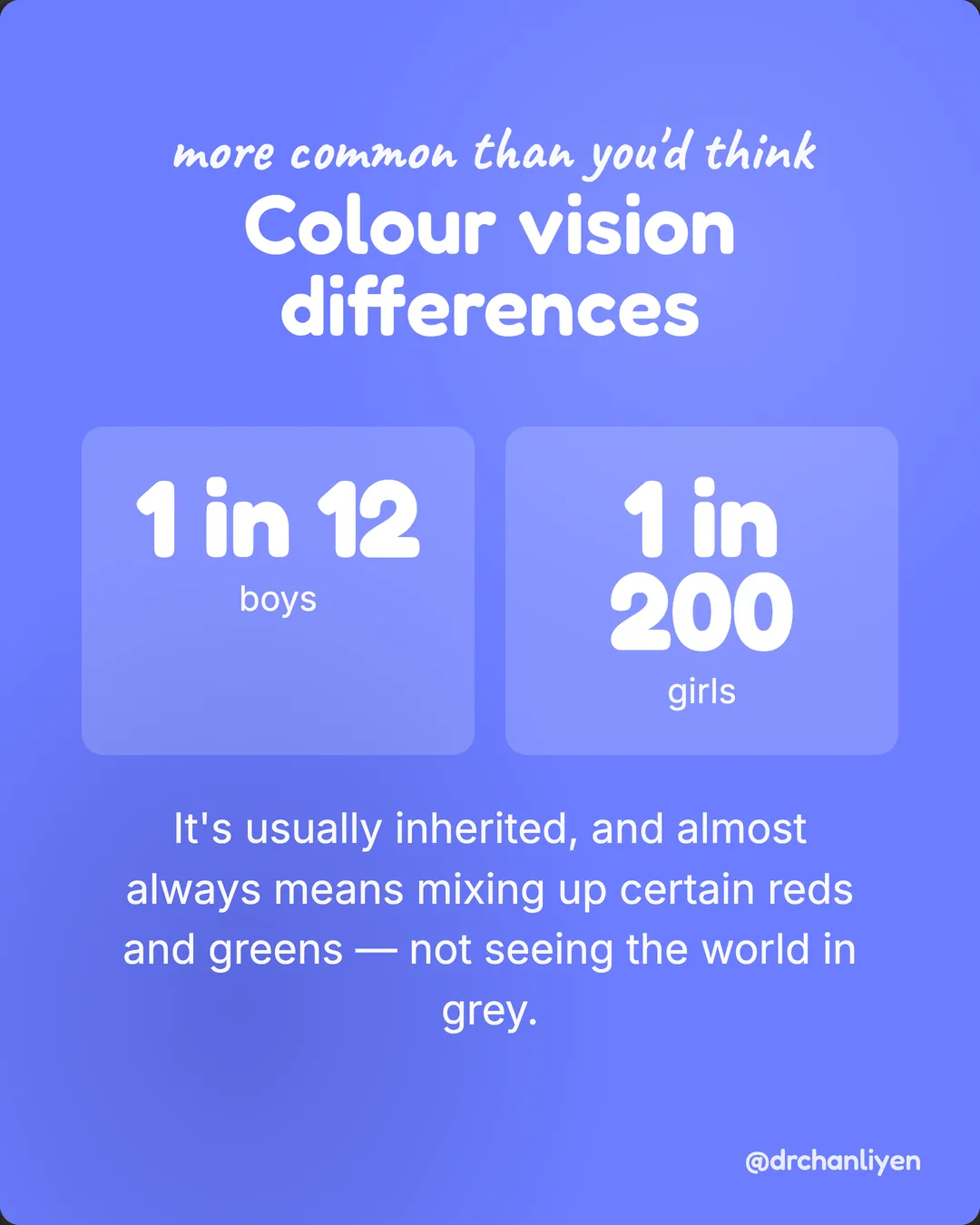
- It is inherited on the X chromosome, so it is far more common in boys, and a mother did nothing to cause it.
- A simple book of coloured dot patterns can check for it, and a child only needs to be willing to say what he sees in the dots.
- There is no cure and no treatment, and tinted glasses marketed as a fix change how colours appear rather than restore true colour vision.
- Telling the school matters more than any device, because worksheets and colour-coded charts can be adapted easily once a teacher knows.
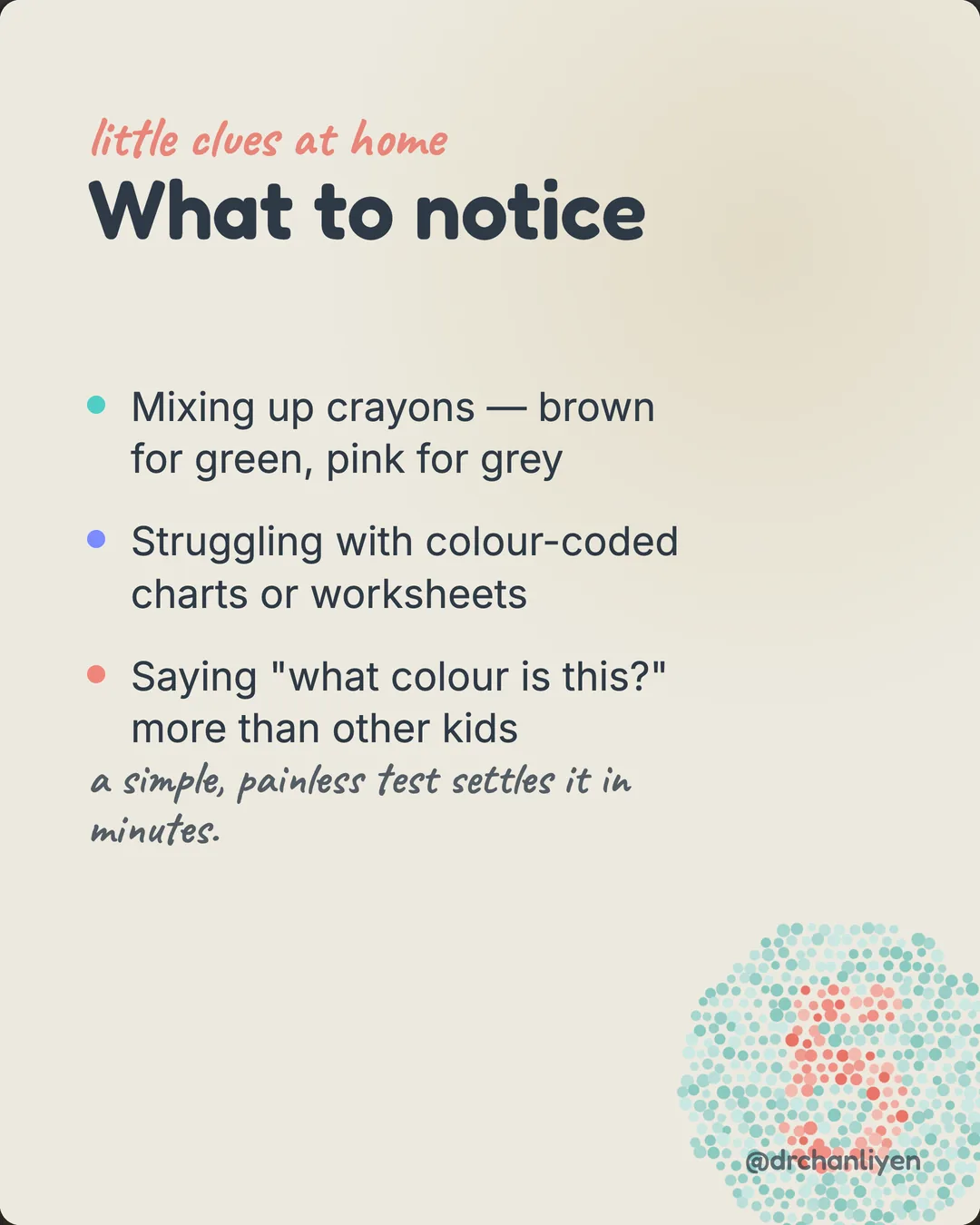
Almost nobody comes to see me because they suspect colour blindness on purpose. It turns up sideways. A child colours the sea purple and the grass brown, or a teacher mentions, gently, that he keeps mixing up the red and green groups on a worksheet, or he calls a maroon jumper green with total confidence and no one at home can talk him out of it. Malaysian school screening does test for it, just late.
The school health team runs the Ishihara dot-pattern plates at Tahun 6 and again at Tingkatan 3, in the government and government-aided schools it visits. A pupil who fails is referred to an eye clinic for confirmation and career counselling. So it is checked. It is also checked years after the first colour-coded worksheet, which is why a colour mix-up is so often noticed at home or by a teacher first: by accident, not by design.
None of that means something is wrong with your child's eyes in the way a blur or a turned eye would be. It is a different kind of difference, and it is one of the calmer conversations I have in clinic.
How do most parents find out their child sees colour differently?
Through a small, repeated pattern rather than a single dramatic clue. A child who names the wrong colour once is probably still learning his colours. A child who names the same colour wrong every single time, over weeks, in the same consistent way, is telling you something more specific. Purple skies and green skin in a drawing can simply be a four-year-old being an artist. What I listen for is consistency: the same swap, again and again, across different days and different pictures.
A teacher's comment often does the noticing before a parent does, because a classroom puts a child in front of colour-coded charts and group labels every day, in a way home life rarely does.
Parents sometimes worry they missed something at home, and I want to head that off early: colour is one of the few things a child cannot describe to you accurately until he has the vocabulary for it, so a mix-up that would have been obvious in a squint or a blur can sit unnoticed for years without anyone doing anything wrong.
What does colour blindness mean?
Usually not what the name suggests. Most people who are colour blind see partial colour rather than a grey world. Seeing no colour at all does exist, but it is not the usual picture. The far milder version, and the common one, is a child who confuses certain shades of red and green with each other. Blue-yellow confusion happens too, but it is less common.
So the honest picture is a child seeing a full, colourful world, just one where a handful of reds and greens sit closer together than they do for everyone else at the table. Sharpness of vision is not affected. This is a colour question, not a seeing question, which is a genuinely different thing from the focusing problems that lead a child to need glasses.
How do you test for it, and how young can a child be?
With a book of coloured dot patterns, and younger than most parents expect: what the test asks of a child is that he tells me what he sees in the dots, not that he can read well.
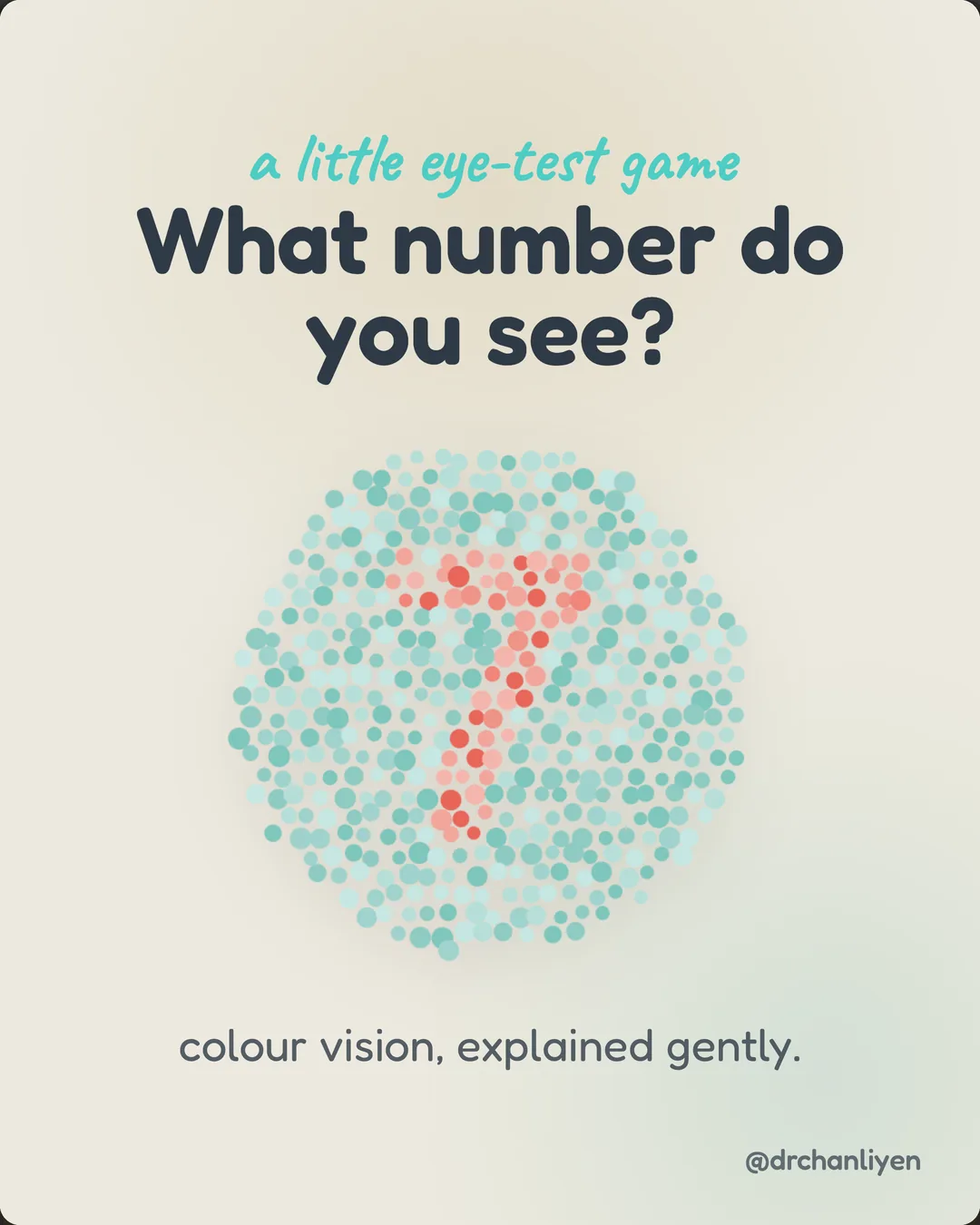
The book itself is the kind most parents have glimpsed somewhere: a circle made up of dozens of dots in slightly different shades, with a number or a shape hidden inside for a child with typical colour vision to pick out. Nothing touches the eye, and it sits alongside the rest of a child's eye check.
The part parents are usually surprised by is that there is no exam to revise for and no birthday to wait for. A school-age child reads out the number hidden in the dots, and that is the whole test.
A younger child needs more patience from both of us, and a child who is simply not in the mood on the day has told me nothing at all about his colour vision, so we come back to it another time rather than writing down a result. Willingness settles this, not a number of years.
Why is it mostly boys, and did I do this to him?
Because colour blindness is usually carried on the X chromosome, and it is passed from mother to son. A boy has only one X chromosome, so if it carries the gene, nothing else steps in to cover for it. A girl has two X chromosomes, so she usually needs the gene on both to be affected, which is why it shows up in girls far less often. This is why it runs noticeably down a family line, and why it turns up far more often in boys than in girls.
If you are reading this wondering whether you gave this to your son, the answer is no, not in any sense that involves fault. A gene is not a decision. You did not do anything differently, more carefully, or more carelessly than any other mother, and nothing about pregnancy, diet, or screen habits changes an X-linked pattern that was already written before he was born. I say this outright in clinic because I watch mothers carry this guilt quietly, and it belongs nowhere near this diagnosis.
What does it change day to day?
Honestly, not very much, and it is worth saying that plainly rather than dressing it up. Most children with mild colour vision deficiency go through ordinary school days without anyone else ever knowing. A few practical things are worth putting in place early, though.
At school, colour-coded worksheets, graphs, and maps are the places it actually shows up, so telling the teacher is the single most useful thing you can do. Most teachers can adjust simply, by adding labels or patterns alongside colour, once they know. At home, reading labels rather than relying on colour helps with things like ripeness, doneness, or which cable goes where.
Later on, it is worth knowing that a small number of careers, such as pilot or train driver, do have colour-vision requirements, so a teenager weighing those paths benefits from knowing his result years in advance rather than discovering it at an application stage. Outside those specific situations, colour blindness closes very few doors.
Can it be cured, and do those special glasses work?
No, it cannot be cured, and the tinted glasses shift how colours look rather than putting back what is missing. I say this early and clearly because parents understandably go looking for a fix once they hear a diagnosis. Inherited colour blindness is lifelong. There is nothing to treat, and it does not resolve on its own.
You will come across glasses and contact lenses marketed as a cure for colour blindness. Be wary of that framing. What those tinted lenses actually do is shift how certain colours appear, filtering some wavelengths so a handful of confused colours look more different from each other to some wearers. That can be a genuinely interesting experience for a child to try, the sort of thing that makes a good weekend story.
It is not the same as restoring normal colour vision, and it will not change what the dot-pattern test shows underneath the lenses once they come off. There is nothing wrong with trying a pair for fun, as long as your child understands, in language he can hold onto, that it is not a repair and not a reason to stop being told about his result at school.
Is there anything else I should watch for?
How clearly he sees, which is a separate question from how he sorts colours. Colour vision deficiency does not affect sharpness of vision, so if the colour mix-ups sit alongside blurred vision, that blur is its own problem and deserves its own proper look, the same way a child sitting unusually close to a screen deserves a look rather than an assumption. A colour result does not explain away a blur.
The other thing worth watching is schoolwork, because colour vision deficiency may affect a child's performance at school. If colour-coded worksheets, graphs, and maps seem to be holding him back, that is a reason to have his colour vision checked properly and to tell his teacher, not a reason to think he is not trying. Once lessons and exams are adjusted, most of that difficulty goes quiet again.
Past those two things, though, my message to parents is a simple one. Your child is not seeing less of the world. He is seeing it organised a little differently, and once his teacher, his family, and eventually he himself know that, it stops being a worry and becomes just one more fact about him, alongside his shoe size and his favourite colour, whichever colour that turns out to be.
- Colour confusion alongside blurred vision. Colour vision deficiency does not affect how sharply a child sees, so blur is a separate problem and needs its own check.
- Colour-coded schoolwork that seems to be holding your child back. Colour vision deficiency may affect a child's performance at school, and lessons and exams can be adjusted once the school knows.
- A colour mix-up that repeats in the same way and has never been tested. A book of coloured dot patterns checks it properly rather than leaving you guessing.
- Any colour vision concern in a girl. It is possible, just uncommon, and worth confirming rather than assuming a mistake.
Common questions
Is it my fault if it runs on my side of the family?
How to tell if my child is colour blind?
What age can he be tested?
Can colour blindness be cured?
Will it affect him at school or his future job?
What does he actually see? Is everything grey?
Do those colour-blind glasses actually work?
Are girls ever colour blind?
- AAPOS · Color vision deficit · aapos.org
- American Academy of Ophthalmology · What is color blindness · www.aao.org
- NHS · Colour vision deficiency · www.nhs.uk
- American Academy of Ophthalmology · Common eye myths and facts · www.aao.org
- Bahagian Pembangunan Kesihatan Keluarga, KKM · Laporan Tahunan 2018, in Bahasa Malaysia (school health screening, Ishihara colour vision test at Tahun 6 and Tingkatan 3) · hq.moh.gov.my