Why does my child sit so close to the screen?
Nose to the iPad, forehead nearly on the TV. Most of the time this is a young eye doing exactly what it is built to do. What matters is knowing the difference between habit and the first sign of short-sightedness.

- A young child's focusing system is unusually strong, so sitting close is normal, immersive behaviour, not a sign of damage.
- Closeness becomes worth checking when it appears alongside squinting, whiteboard complaints, or headaches, because it is one of the ways short-sightedness first shows.
- Screens tire the eyes temporarily, but that strain does not cause permanent damage.
- Outdoor time, roughly one to two hours a day, has good evidence behind it for stopping short-sightedness starting. Once it has started, slowing it down is a separate conversation with an eye doctor.
- The American Academy of Ophthalmology sets no eye-health hour limit for screen time, so an hour figure quoted to you is a rule of thumb rather than an eye doctor's instruction.
Nearly every week, a parent describes it to me the same way: nose almost touching the iPad, forehead an inch from the TV, and a low hum of guilt underneath the question. Is he doing this because I let him have too much screen time? Almost always, no. Sitting close is one of the most ordinary things a young child's eyes do. Occasionally, though, it is the first sign of something worth checking. This is how to tell which one you are looking at.
Why does my child sit so close to the screen?
Because a young child's focusing system is remarkably strong, and sitting close is often simple immersion rather than any kind of strain. Children have far more focusing power in reserve than adults do. A four-year-old can hold a sharp, comfortable image at a distance that would give me a headache.
Sitting close is not a struggle to see; for many children it is a choice, the same instinct that makes them lean into a book or crouch beside an ant trail. The picture fills more of their view from there, and that is simply more interesting.
Habit plays a part too. A child who has always watched from the floor, close to the screen, has no reason to move back unless someone asks them to. Some children also like the way a screen fills their whole view and shuts out a busy living room. None of this means anything is wrong. It means you have a small person doing what small people do, which is get as close as possible to the thing that has their attention.
I want to say the guilt part plainly, because it is the part most parents carry into my clinic without saying out loud. A pandemic of online school, a busy household, a tablet that bought you twenty quiet minutes to cook dinner: none of that has broken your child's eyes. Ordinary screen use is not the villain this worry makes it out to be.
When is sitting close a sign of a problem?
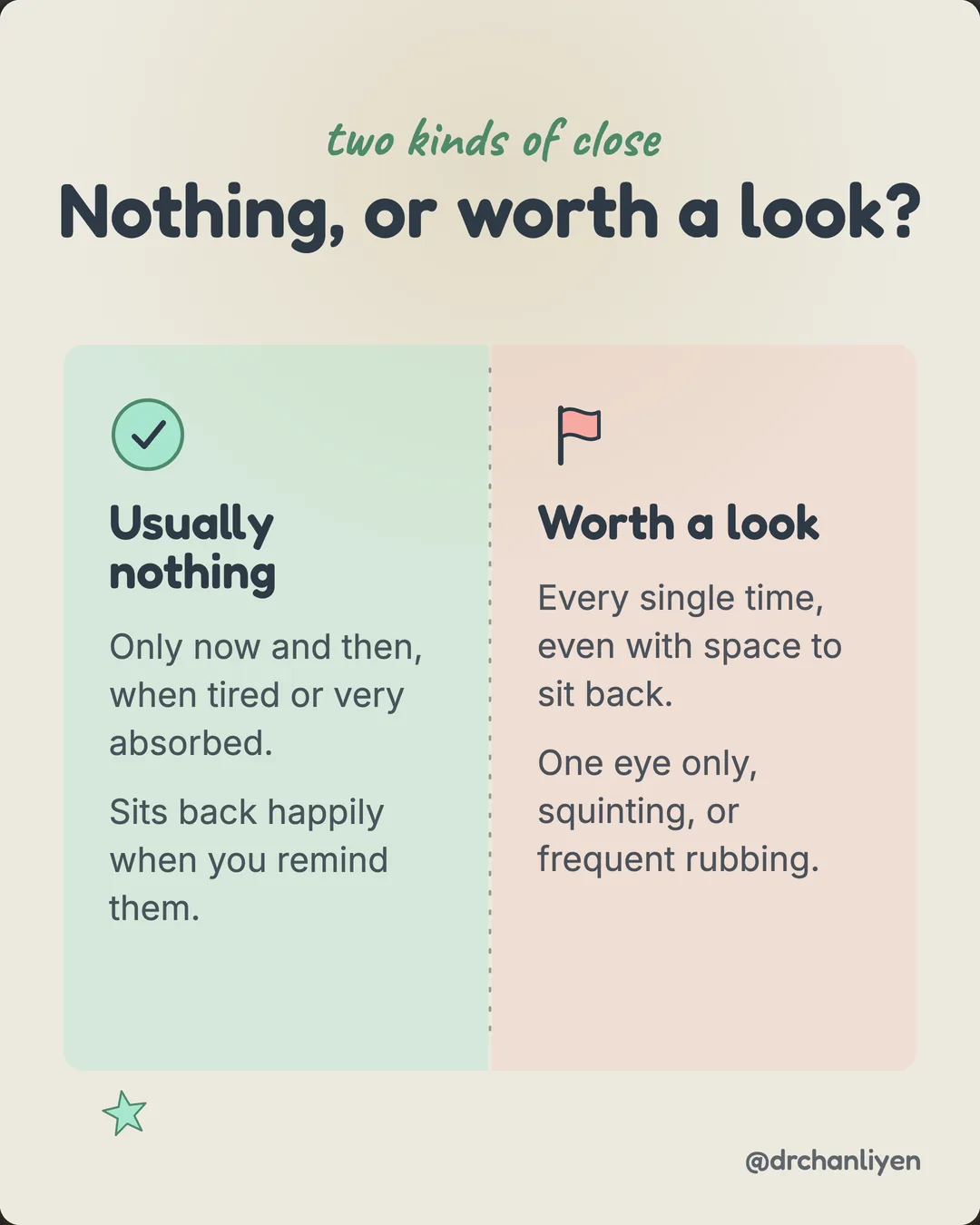
When it appears alongside other signs, because closeness is one of the ways short-sightedness, the rabun jauh on a Malaysian prescription slip, first announces itself in a young child. On its own, sitting close proves very little. But watch for squinting or screwing up the eyes to bring a screen or a whiteboard into focus, complaints of not being able to see the board at school, a tendency to move seats or desks to get nearer to things, or headaches that turn up around schoolwork and screen use.
A child who has always sat close and shows none of this is probably just a child who likes being close. A child who has newly started sitting closer, and is also squinting or complaining, deserves a proper eye test, not a guess from across the room.
School screening is not a reliable substitute for that test. The school health team measures vision at Tahun 1, Tahun 6 and Tingkatan 3, and in the government and government-aided preschools it visits. The klinik kesihatan does an eye check at four: an outside look at the eyes, vision in each eye, and a light reflex test.
A child in a private tadika may miss that preschool visit unless you arrange a check. Each of these is a quick pass or refer screen, not a full examination. If your child's screening result and your own eyes disagree, believe your own eyes and book the appointment.
Is it true that sitting close ruins your eyes?
Not in the way grandparents mean it, though their instinct to watch for it is sound. The direction of cause and effect is the part that gets flipped. Sitting close does not damage a child's eyes. Short-sightedness, though, is one of the things that puts a child there, because moving nearer is how a blurred screen becomes a sharp one.
Grandma is reading the sign correctly and naming the wrong cause. I would rather keep her watchfulness than dismiss the observation. If a grandparent in your house insists on this, you can tell them, kindly, that she is right to notice, and that noticing is exactly what earns her a place at the next eye appointment.
What does screen use do to a child's eyes?
It tires them, temporarily, and that is the whole of it. Long stretches of close, fixed focusing bring on eye strain: a heavy, achy feeling, occasional blurring, eyes that feel dry or want to be rubbed. It is a real sensation and worth taking seriously in the moment, but eye strain does not injure the eye and does not cause permanent damage.
There is also no good evidence that the blue light from ordinary screens harms a child's eyes. If your child seems tired or irritable after a long stretch on a device, that is fatigue asking for a break, not proof of harm already done. The research on the wider question is weighed in what the studies show on screen time and short-sightedness.
Parents often ask me for a safe number of hours. I understand the appeal of a number; it is something to hold onto. But the American Academy of Ophthalmology sets no screen-time hour limit for children's eyes, so treat any hour figure quoted to you, an app setting, a school pamphlet, a well-meaning auntie, as a rule of thumb for the household rather than an eye doctor's instruction. What actually helps is a habit, not a countdown timer.
What matters more than screen time for preventing short-sightedness?
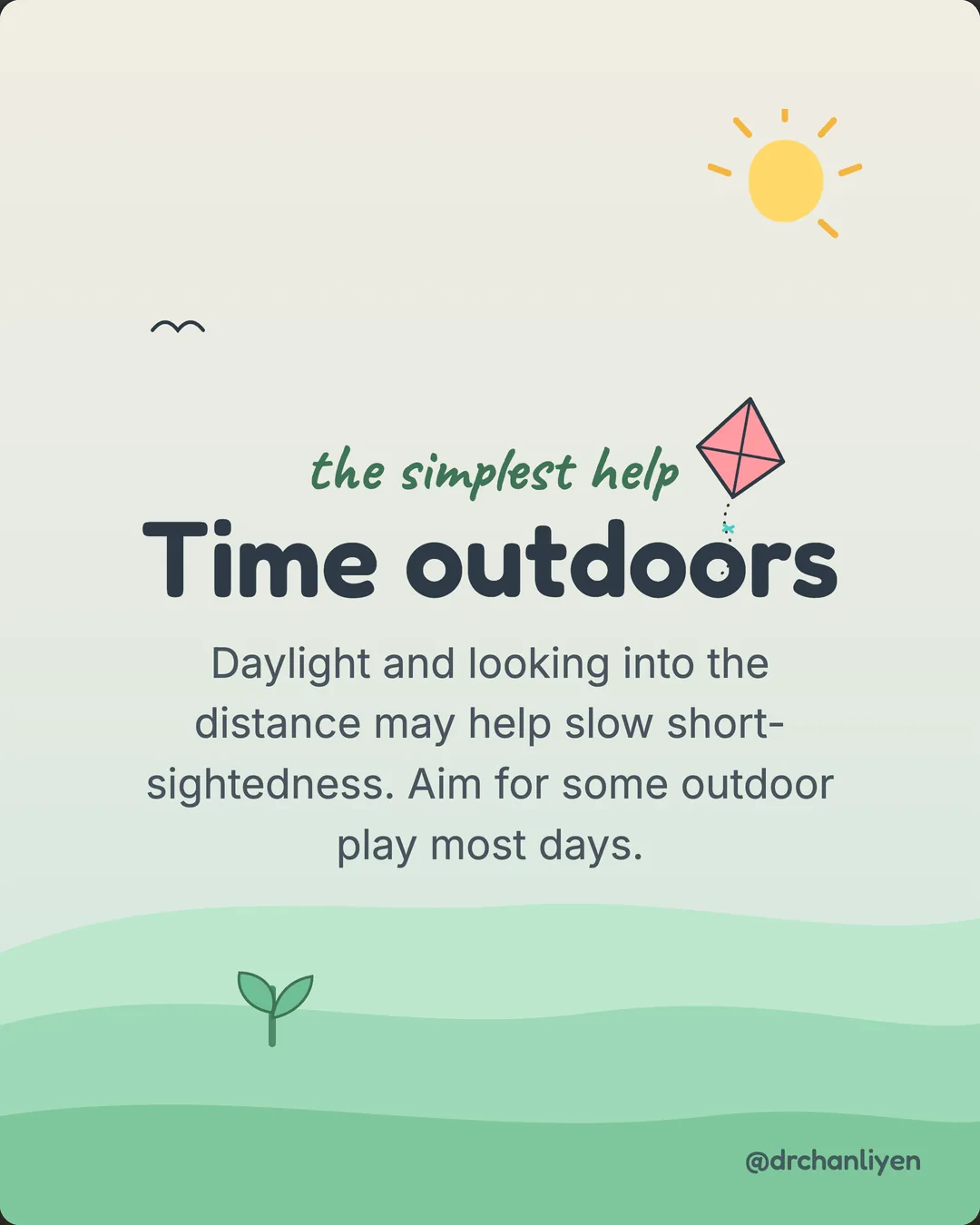
Time outdoors, and by a wide margin. More time outside is linked to fewer children becoming short-sighted later, and the American Academy of Ophthalmology's advice to parents is roughly one to two hours outdoors a day. The explanation usually given is that daylight raises dopamine in the eye in a way that helps regulate how the eye grows.
Screens indoors, under artificial light, simply do not offer that. Outdoor time is a harder sell in Malaysian heat and haze, and harder still on a day with tuition after school. It does not have to be a park trip. Sunlight on the walk to the car counts, and so does a Saturday morning at the playground.
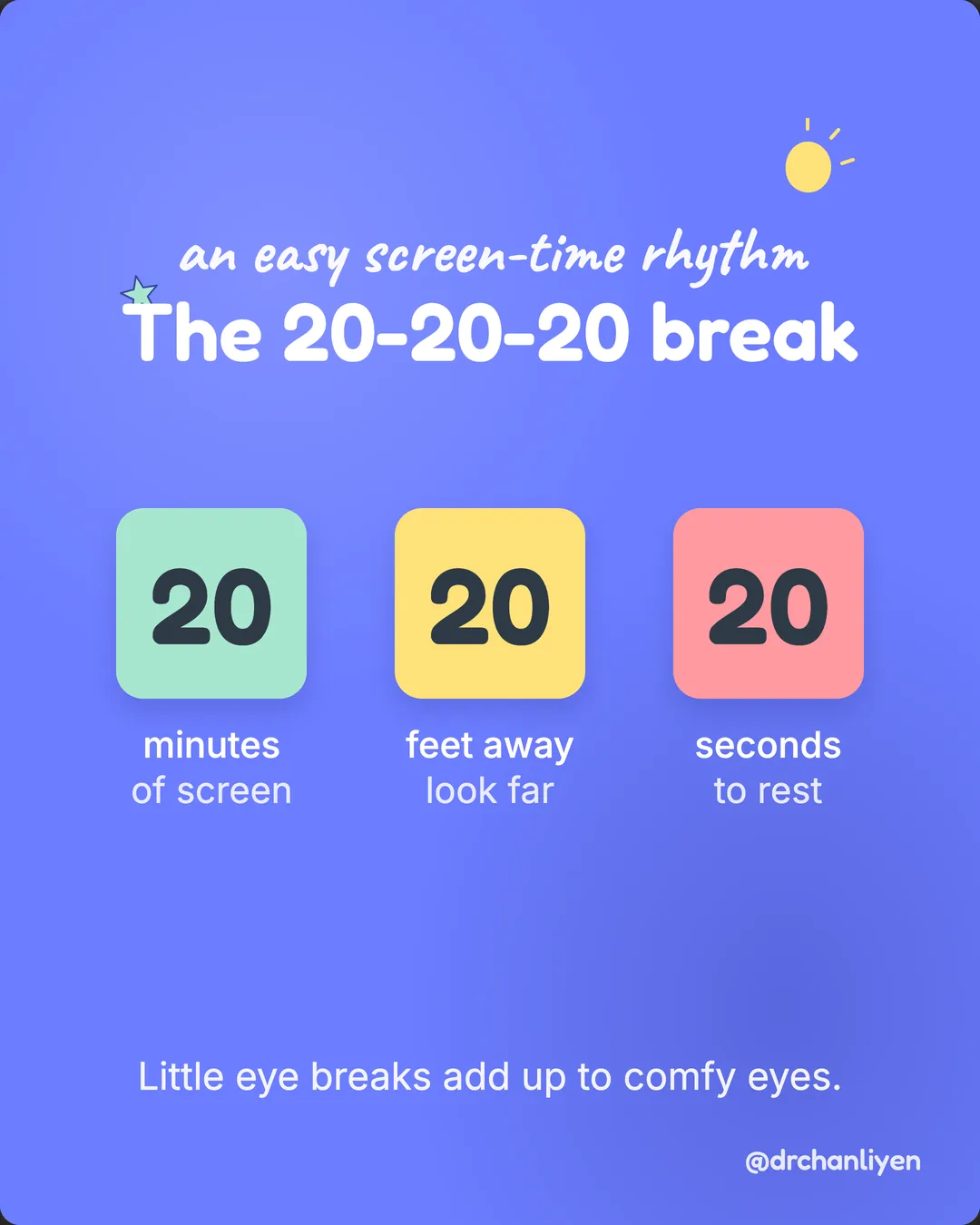
The 20-20-20 habit is worth keeping too, used correctly: every twenty minutes, look at something at least twenty feet away for at least twenty seconds. It gives the focusing system a break during long near tasks, whether that task is a screen or a workbook, and it costs nothing to try.
Why does it feel like every child I know needs glasses now?
Because short-sightedness genuinely is rising, and rates across East and Southeast Asia are among the highest recorded anywhere. A precise Malaysian figure is not something I can quote with confidence, because the good local data is not there yet. If it feels like more classmates are in glasses than when you were at school, that is not your imagination.
This is also why the closeness you notice at home is worth taking seriously, and why regular eye checks matter even for a child who seems to be seeing fine, because the eyes can drift off course quietly, without complaint, until someone looks.
If my child is already short-sighted, can anything be done?
Short-sightedness itself cannot be reversed once it has developed, and any promise otherwise is worth questioning. What can be done is slowing how quickly it progresses, the yearly "power naik" so many Malaysian parents sigh about at the optical shop, and slowing that climb is the entire idea behind what is called myopia control. This is a category of options an eye doctor discusses with you, not a single product: low-dose atropine drops used over several years, particular spectacle lens designs, specific contact lenses, and the overnight lenses called orthokeratology.
The outdoor time already mentioned has its evidence for stopping short-sightedness starting, not for slowing it once it has started. Whether any of it suits your child, and which option, is a conversation to have at the appointment. If your child has recently been prescribed their first pair of glasses, that appointment is also the natural place to ask whether their prescription is the kind worth watching for faster than usual change.
Two short-sighted parents do not doom a child to the same fate, though that does raise the odds enough to be worth a slightly closer watch. Genetics load the dice, but habits still matter, and a family that gets outdoors together and keeps regular eye checks is doing real work against those odds, not just waiting to see what happens.
Most children who sit close to a screen are simply children enjoying a screen. Watch for the company that closeness keeps, squinting, complaints, headaches, a prescription climbing faster than expected, rather than the closeness alone, and you will rarely be caught out either way. If the prescription is the thing climbing, myopia control in Malaysia sets out the options and the routes, and what the evidence actually shows.
- Your child sits close and also squints, screws up their eyes, or tilts their head to see clearly.
- They complain of not being able to see the whiteboard, or move desks or seats to get closer.
- They get frequent headaches, especially after schoolwork or screen use, or rub their eyes a lot.
- Their glasses prescription has climbed noticeably in the last year.
- Both parents are short-sighted and no one has checked your child's eyes in the last one to two years.
Common questions
Have I damaged my child's eyes by letting them use the iPad so much?
How much screen time is safe for my child's eyes?
Does blue light from screens harm children's eyes?
My child sits close to the TV but the school screening said her eyes are fine. Do I still worry?
My mother says sitting close ruins your eyes. Is she wrong?
Can short-sightedness be reversed once it starts?
Is the handphone worse for the eyes than the TV?
- American Academy of Ophthalmology · Prevent childhood myopia with sunshine and outdoor time · www.aao.org
- American Academy of Ophthalmology · What is eye strain · www.aao.org
- American Academy of Ophthalmology · Screen use in kids · www.aao.org
- American Academy of Ophthalmology · Myopia control in children · www.aao.org
- American Academy of Ophthalmology · Digital devices and your eyes · www.aao.org
- Portal MyGovernment · Kesihatan Sekolah untuk Murid Pra-Sekolah · www.malaysia.gov.my
- Kementerian Kesihatan Malaysia · Rekod Kesihatan Bayi dan Kanak-kanak 0-6 tahun, Pindaan 03/2021 (versi perempuan) · hq.moh.gov.my
- American Academy of Ophthalmology · Common eye myths and facts · www.aao.org
- American Academy of Ophthalmology · Can close TV viewing damage eyes · www.aao.org
- Bahagian Pembangunan Kesihatan Keluarga, KKM · Laporan Tahunan 2018 · hq.moh.gov.my