Blocked tear ducts: what's normal, what's not
A watery, gunky eye in a young baby is almost always plumbing, not infection. How to tell the difference, the massage that genuinely helps, and a kind word about the breast milk advice from your mother-in-law.

- More than 5% of babies have a watery or sticky eye from a blocked tear duct, in one eye or in both.
- About 90% clear on their own during the first year, without any procedure at all.
- Firm downward pressure with a finger over the inner corner of the eye helps clear mucus and open the membrane inside the duct.
- Cooled boiled water on a fresh cotton pad, a new pad for each wipe, is a safe way to clean the eye. Nothing needs to go into the eye to treat the blockage itself.
- A red, angry eye, or a painful swollen bump beside the nose with yellow-green discharge, is not a simple blocked duct and needs to be seen at once.
Few weeks pass in this clinic without a baby arriving with one wet, gunky eye and a parent whose opening line is the same: is this an infection? Usually the answer is no. More than 5% of babies have symptoms of a blocked tear duct in one or both eyes, sometimes flagged first at a baby's first eye check. It looks alarming from the outside. It is, most of the time, simple plumbing.
Why do so many babies have a watery or sticky eye?
Because a thin membrane inside the tear duct has not opened yet, and until it gives way tears cannot drain. Tears do not just well up and spill; they are meant to drain away through a tiny duct at the inner corner of the eye, down into the nose. While that membrane stays shut, tears pool in the eye instead of draining, then spill over or thicken into the crust you find on her lashes each morning.
The blockage is in the drainage channel, not in the eye's ability to make tears. Provided the eye stays white and calm, and the signs further down this page are absent, it is the drain that is slow to open, not the tap that is faulty.
Parents often ask whether they missed something at the newborn check, as if a watery eye noticed weeks later means an earlier warning sign was overlooked. It usually was not. This is a problem that can announce itself on its own timetable, sometimes in the first days, sometimes only once a baby is settling into weeks of ordinary crying and feeding, and a slightly later start is not a red flag by itself.
What does a blocked tear duct actually look like day to day?
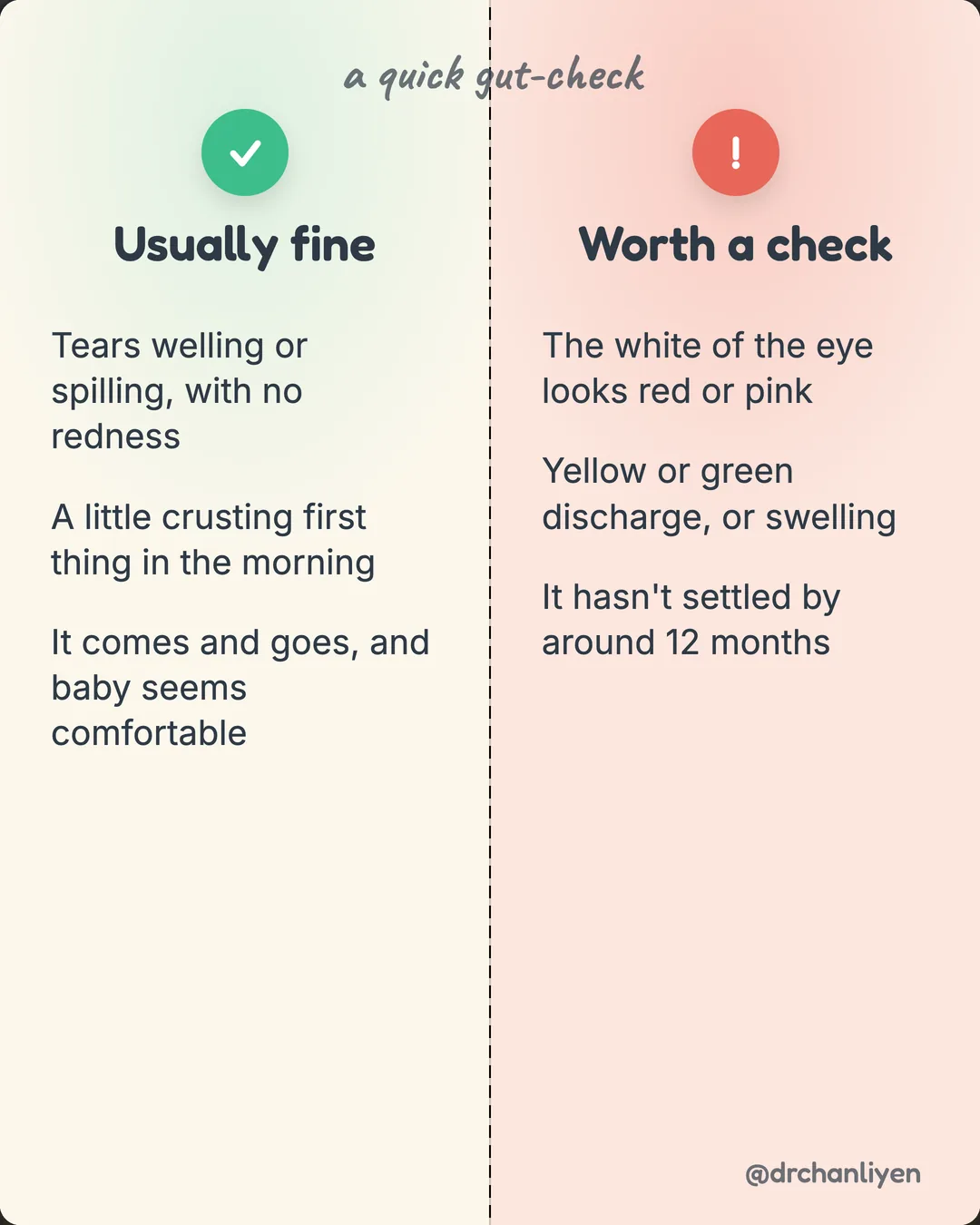
A watery eye that stays white and calm, on a baby who is otherwise entirely herself. You will likely notice tears sitting on the lower lid or running down the cheek even when she is not crying, and crusting along the lashes after sleep, sometimes enough to glue them shut overnight.
Wipe it away and the eye underneath looks ordinary: no redness, no swelling, no sign that she is bothered by it. That calm white is the part I would watch. A blocked duct leaves the white of the eye quiet; a white that has turned pink or red is a different question, and one worth asking sooner rather than later.
How exactly do I do the tear duct massage?
With a clean finger and a gentle but firm downward stroke over the little tear sac beside the nose, just below the inner corner of the eye. The name you may see written down for it is Crigler massage, and the idea behind it is simple: that downward pressure helps clear mucus and open the membrane.
Wash your hands first, use a soft touch rather than a poke, and work in a downward line rather than rubbing in circles. Build it into a moment you already have together, after a feed or before a nap, rather than treating it as a medical procedure to dread.
It will not work overnight, and that is expected rather than a sign you are doing it wrong. Keep the habit going and give the duct time to open. If your baby squirms or fusses at the touch, a shorter, calmer attempt beats a longer, tense one; there is no prize for finishing a set number of strokes, only for keeping at it gently over days and weeks.
What tells us this is not just a blocked duct?
A change in the eye or the skin around it, rather than just the watering. A painful, red, swollen bump on the skin beside the nose, with yellow-green discharge, points to an infection of the tear sac, what we call dacryocystitis, rather than a simple blockage. With a fever, or a baby who seems unwell with it, that picture is a medical emergency: it needs antibiotics and it needs them straight away, not a wait-and-see. It looks and feels like something is genuinely wrong, not just untidy.
A white of the eye that has turned pink or red, in one eye or both, is a different question again. That is the picture of conjunctivitis, what most people call pink eye, which unlike a blocked duct can spread easily from person to person; I have written about telling pink eye apart and what actually helps separately. One age rule overrides everything else on this page: a baby under a month old with a red or sticky eye needs to be seen urgently rather than watched at home.
There is also a rarer pattern worth knowing, because it is easy to mistake for the same watery eye and it is not. If your baby seems bothered by ordinary light, screws up or squeezes one eye shut, or if the clear window at the front of the eye, the cornea, looks hazy or one eye looks bigger than the other, this can point to a pressure problem inside the eye, childhood glaucoma, rather than a blocked duct.
It is uncommon, but it can worsen quickly, so those particular signs deserve an urgent look rather than a wait-and-see. I go through exactly what we check for at that kind of visit in how we test a baby's eyes before they can read, and a cloudy or unusually large eye belongs in the same urgent category as a white glow spotted in a photograph: worth ruling out properly rather than assuming all is well. How soon each of these should be seen is laid out in is this urgent?.
Is it true that breast milk in the eye can clear it up?
I would not do it, and nothing is lost by leaving it out. I hear this a great deal, often from a well-meaning grandmother, and I understand exactly why it has stuck around: it feels like a natural, gentle thing to try.
The blockage sits in the drainage channel between the inner corner of the eye and the nose, and what opens it is time and the downward massage described above. Time and pressure, not a substance in the eye. The research behind that advice is in a separate article, what the evidence says about breast milk in a sticky eye.
There is a separate, practical reason to be careful here too: I would rather nothing unsterilised went into an eye that is already struggling to drain, breast milk included. For cleaning away the crust each day, cooled boiled water on a fresh cotton pad for each wipe is the safer choice, and it does the job perfectly well.
Wipe from the inner corner outward, use a new pad for each pass, and there is no need to scrub; the crust lifts away easily once it is softened. Kohl is another remedy that deserves the same kind answer: see kohl or celak on a baby's eyes.
I try to answer this one kindly rather than dismissively, because the advice usually comes from someone who loves your baby and is trying to help in the way she once helped her own children. You can thank her for the thought and still choose the water and cotton pad instead. Both things are true at once, and neither cancels the other out.
When does a blocked tear duct need more than time and massage?
About 90% resolve on their own during the first year of life, which is why I ask most families to simply keep going with the massage and wait it out.
If the watering and crusting are still there as your baby approaches her first birthday, or if symptoms are unusually severe before then, that is when we talk about referral for probing, the procedure used to open the duct. Most families never reach that conversation, and it is better explained properly at the point we actually get there than carried around as a worst-case picture for months beforehand.
Am I doing enough if I just wait and keep the eye clean?
One aside for the adults reading this, because there are always a few. A watery eye that begins in adult life is a different problem from your baby's. The duct has usually narrowed or scarred rather than never having opened, time does not resolve it in the way it resolves a baby's, and the operation that fixes it is not the small procedure I have just described.
Dr Catherine Chow, a consultant oculoplastic surgeon, has written about why an adult eye keeps watering and what actually opens a blocked duct. This page is written for babies. Hers is the one written for you.
Yes. Keeping the eye clean, keeping up the massage, and knowing the handful of signs that mean look again sooner is the whole of the job here, and it is a real job even on the days it feels like doing nothing. A blocked tear duct is common, it looks worse than it is, and it very nearly always settles without anything dramatic being done to fix it.
Waiting well is not the same as ignoring it: you are watching a healthy eye finish a piece of plumbing, and you know what would change your mind. The rest is time doing its work quietly while your baby gets on with being a baby.


- The eye or the skin beside the nose looks red, angry, or swollen rather than just watery.
- There is a painful, red, swollen bump on the skin beside the nose with yellow-green discharge, especially with fever or a baby who seems unwell. Treat that as an emergency.
- Your baby seems bothered by light, screwing up or squeezing the eye shut.
- The cornea, the clear window at the front of the eye, looks cloudy, hazy, or unusually large, or one eye looks bigger than the other.
- Your baby is under a month old and the eye is red or sticky. At that age it needs to be seen urgently rather than watched.
Common questions
My mother-in-law wants me to put breast milk in my baby's eye, is that safe?
How long should I keep doing the massage?
Is the discharge contagious, will it spread to other children?
Will my baby need surgery to fix this?
Why does only one of my baby's eyes water and not the other?
My baby's eye is watery but not red, do we still need to see a doctor?
Could this actually be conjunctivitis instead of a blocked duct?
- AAPOS · Nasolacrimal duct obstruction (blocked tear duct) · aapos.org
- American Academy of Ophthalmology · Childhood glaucoma · www.aao.org
- NHS · Conjunctivitis · www.nhs.uk
- NHS · Red eye · www.nhs.uk