Eye safety at home: the accidents I see, and how to stop them
Most of the eye injuries I treat did not happen at a playground or on a sports field. They happened at home, in the seconds it takes to reach for the wrong bottle. Here is what actually reaches my clinic, and the one habit that removes each risk.

- About half of all eye injuries in children happen at home, and most of them were preventable.
- The two accidents I see most often in Malaysian families are a laundry pod squeezed at face height and a bottle of superglue mistaken for eye drops.
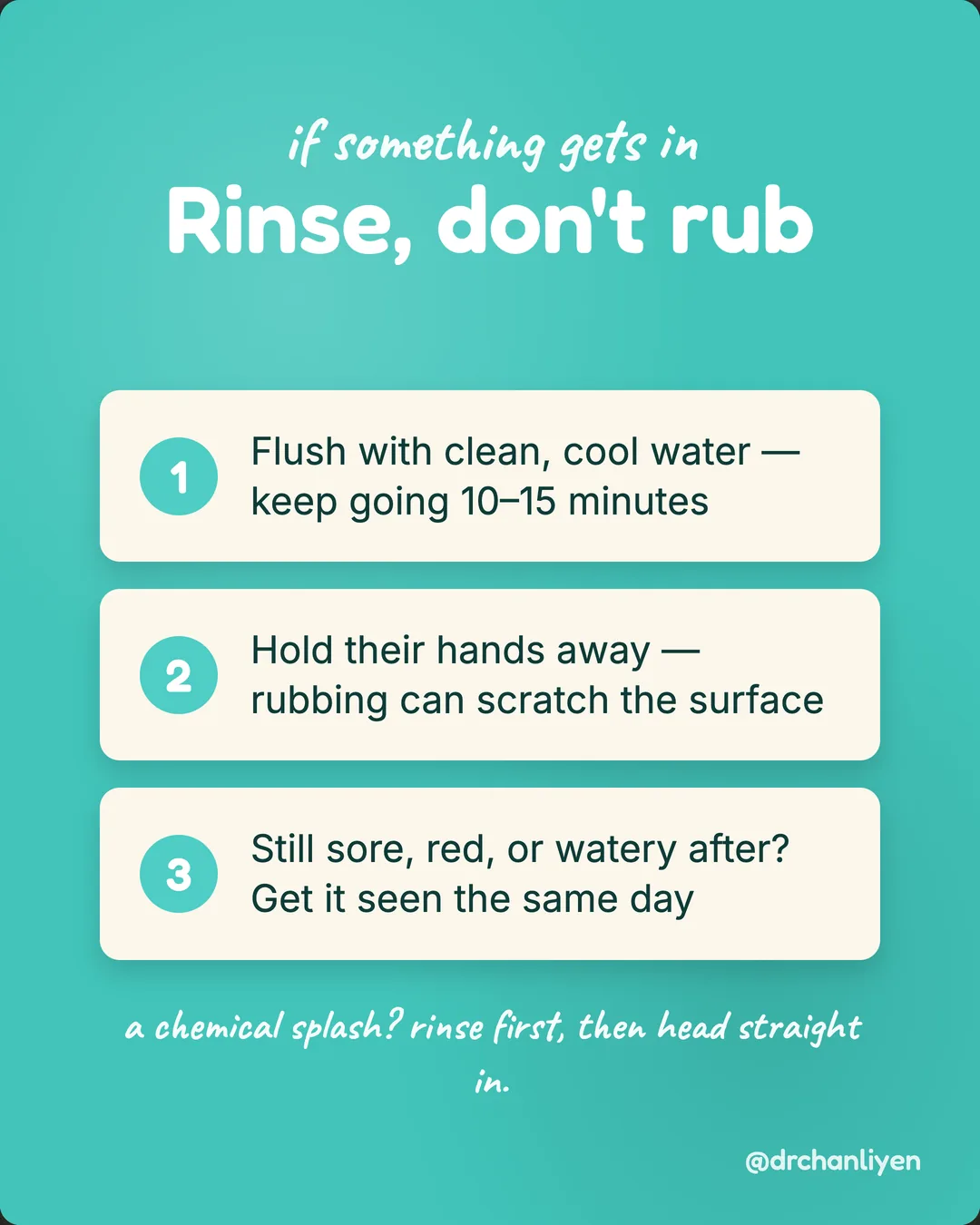
- If a chemical goes into the eye, rinse with any clean water you can reach for ten to fifteen minutes, then go straight to emergency.
- If something has cut or gone into the eye, do the opposite: do not rinse, do not press, do not pull anything out. Shield it loosely and go.
- Wearing proper eye protection during sport can cut the risk of injury dramatically, and any child with one weaker eye should wear it every time.
Parents picture eye injuries happening somewhere dramatic: a playground, a bicycle, a fight with a sibling over a toy. In practice, about half of children's eye injuries happen at home, in an ordinary room, in the few seconds it takes to reach for the wrong bottle or leave a toy on the floor. Most of those injuries were also preventable, which is the part I want this article to leave you with. Not a list of things to fear, but a set of habits that quietly remove the risk.
What kinds of home accidents actually reach an eye clinic?
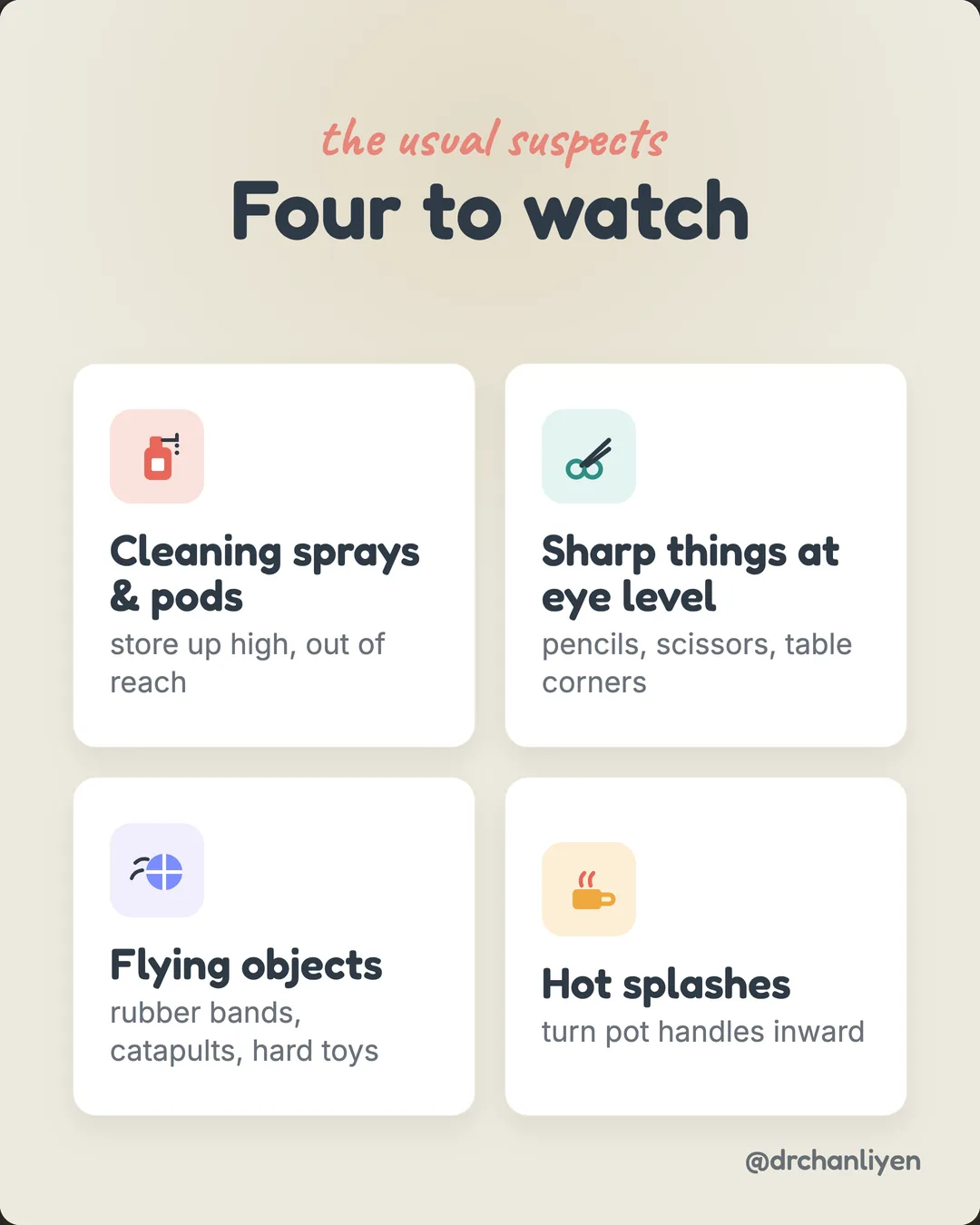
A short list, repeated often: cleaning chemicals splashed near a toddler's face, bottles mistaken for eye drops, projectile toys, a fall onto a table corner, and, around festival time, fireworks and sparklers. Older children add sport to that list, usually a fast ball or a racquet. None of these are exotic. They are ordinary household objects meeting a curious child at exactly the wrong height and the wrong moment.
What they share is a single fix each. Not a general instruction to "be careful", which no tired parent can act on at nine at night, but one specific habit per hazard. That is what the next few sections give you.
How do household chemicals, laundry pods, and superglue end up in a child's eye?
Usually because a spray bottle, a laundry pod, or a small bottle of glue was left within reach at exactly toddler height, and a small hand did what small hands do. Bleach, oven cleaner, window fluid, and kitchen or bathroom cleaners are the usual culprits with sprays and containers, and a splash to the eye can burn the surface of the cornea in seconds.
Laundry pods and superglue are the two mix-ups I warn parents about most. Laundry pods are bright, squeezable, and shaped uncannily like sweets to a toddler, and a squeeze at face height can send concentrated detergent straight into the eye, badly burning the surface. Superglue gets mistaken for eye drops, usually late at night, with a bleary parent reaching for a small bottle on a crowded shelf.
Ear drops, nail glue, and pet medication get grabbed by mistake for the same reason. If it happens, the response is simple and immediate: rinse the eye with water and go straight to an eye emergency service, and whatever the lids are doing, never try to prise them apart at home. Freeing them safely is a specialist's job.
The habit that removes all three risks: store every spray bottle and cleaning supply up high, in a cabinet a toddler cannot climb to. Keep laundry pods in their original container, out of reach and out of sight, never decanted into an open bowl. And keep eye drops in their own labelled space, separate from every other small bottle in the house, reading the label out loud before you use them, especially at night.
What about toys and furniture at toddler height?
Two hazards to name specifically: projectile toys with darts, pellets, or flying pieces, and table corners that sit at exactly the height of a toddler's eye while they are learning to walk. Both cause blunt injuries, the kind from a direct hit rather than a chemical. Toys that fire or beam, and the injuries behind them, are covered in laser pointers, gel blasters and toy guns.
The fix for each is simple and physical, not behavioural. Skip toys with foam darts, pellets, or fishhooks for the under-fives, and choose furniture with rounded corners, or fit corner guards, for the year or so when your child is unsteady on their feet and roughly the right height to meet a table edge face first.
Are fireworks and sparklers safe for children during festivals?
Watching from a distance is fine. Lighting them is not, at any age a young child could plausibly be. Eye injuries from fireworks are among the most severe I see, and a meaningful share end in permanent loss of vision, which is a heavier outcome than most parents expect from something sold in a shop.
The habit here is a simple division of roles: children watch, adults light, and everyone keeps a genuine distance, including from other people's fireworks and sparklers. This applies at Deepavali, at Chinese New Year, and at Hari Raya, wherever fireworks or sparklers appear, not only on the officially licensed occasions. Parties add their own risks, set out in glitter, face paint and party poppers.
Does my older child need eye protection for sport?
For fast-ball and racquet sports, yes. In my clinic that means badminton first, then squash, tennis, hockey, football, and basketball, almost always from a ball, racquet, or another player's elbow arriving faster than a young eye can react to.
The right protection is a proper sports frame with shatter-resistant lenses, not the daily-wear glasses your child already owns, which can shatter on impact instead of protecting against it. If your child already wears glasses for a prescription, ask about a sports version for these games specifically. And if one eye sees less well than the other for any reason, sports eyewear stops being optional. It is the only thing standing between a stray shuttlecock and the eye your child relies on.
What do I do if an eye injury happens?
Chemical in the eye means rinse with clean water straight away, for ten to fifteen minutes, then emergency. Something stuck in or through the eye means the opposite: do not rinse, do not press, do not pull, shield it and go. Everything else in this section hangs off those two opposite rules.
If a chemical goes into the eye, rinse it immediately with any clean water you can reach, holding the eyelid open, for a full ten to fifteen minutes without stopping. Then go straight to an emergency department, bringing the bottle or a photo of its label. This applies to bleach, laundry detergent, superglue mistaken for drops, and anything else that was never meant to touch an eye. Water, straight away, for the full time, then hospital.
If something has cut through the eye or eyelid, or is stuck in or through the eye, do the opposite. Do not rinse with water. Do not press on the eye. Do not pull the object out, however small it looks. Place a clean cup or a proper shield gently over the eye without touching the eye itself, keep your child as calm as you can manage, and go straight to emergency. The same no-rinse, no-pressure, do-not-remove rule applies to a fishhook, a stick, a toy fragment, anything embedded.
For a blow to the eye without a cut, a small cold compress helps with pain and swelling in the first hour. If a black eye develops, or there is pain or any problem with vision, contact a doctor or an emergency department straight away rather than watching it overnight: even a blow that looks minor can hide a serious injury underneath.
For dust or a small particle, blinking and tears usually flush it out on their own. Do not rub. If it stays put, flush gently with clean water or saline and seek help if it will not clear.
Two rules, opposite in direction, both worth keeping ready before you ever need them: chemical means rinse and go, anything stuck or embedded means do not touch and go. Both have their own entry in is this urgent?, alongside the other signs that should never wait.
How do I childproof a whole home for eye safety in one pass?
Walk each room once with this in mind. Cleaning products and detergent pods stored high, in original containers, never decanted. Eye drops kept in their own labelled space, away from every other small bottle. Sharp-cornered furniture guarded or avoided at toddler height. Projectile toys held back until children are old enough to use them sensibly, which is rarely before school age. Fireworks handled by adults only, watched from a genuine distance.
None of this replaces watching your child, and none of it needs to happen all at once tonight. Keep an eye out generally too, the way you would notice a white glow in a photograph or a drifting eye, or ask about it at your child's first eye checks. Eye safety at home is less about vigilance every minute and more about a handful of habits, set once, that quietly do the watching for you.
- A chemical, cleaning product, or glue has gone into your child's eye.
- Anything has cut through the eye or eyelid, or is stuck in the eye.
- There is ongoing pain, blurred vision, or an unusual-looking pupil after any blow to the eye.
- A particle in the eye will not flush out with blinking and tears.
- Your child took a firework or sparkler injury, even a small-looking one.
Common questions
What do I do if my child gets chemical in their eye?
How long should I rinse my child's eye after a chemical splash?
My toddler squeezed a detergent pod into their eye, what now?
I put superglue in my child's eye by mistake, what should I do?
Should I take my child to hospital for an eye injury?
What do I do if something is stuck in my child's eye?
Is a black eye in a child dangerous?
Are fireworks safe for children to watch?
Does my child need sports goggles?
- American Academy of Ophthalmology · Protect your child's eyes from injuries · www.aao.org
- American Academy of Ophthalmology · Eye injuries in the home · www.aao.org
- American Academy of Ophthalmology · Eye injuries from laundry packets on the rise · www.aao.org
- American Academy of Ophthalmology · Eye medication mix-ups · www.aao.org
- American Academy of Ophthalmology · What to do about eye injuries · www.aao.org
- AAPOS · Eye injury and safety · aapos.org