Little eyes in the Malaysian sun: hats, sunglasses and haze
A Malaysian childhood is an outdoor childhood, and that is good news for growing eyes. This is the easy part parents can add on: what to buy, what to say, and what to do on a bad haze day.

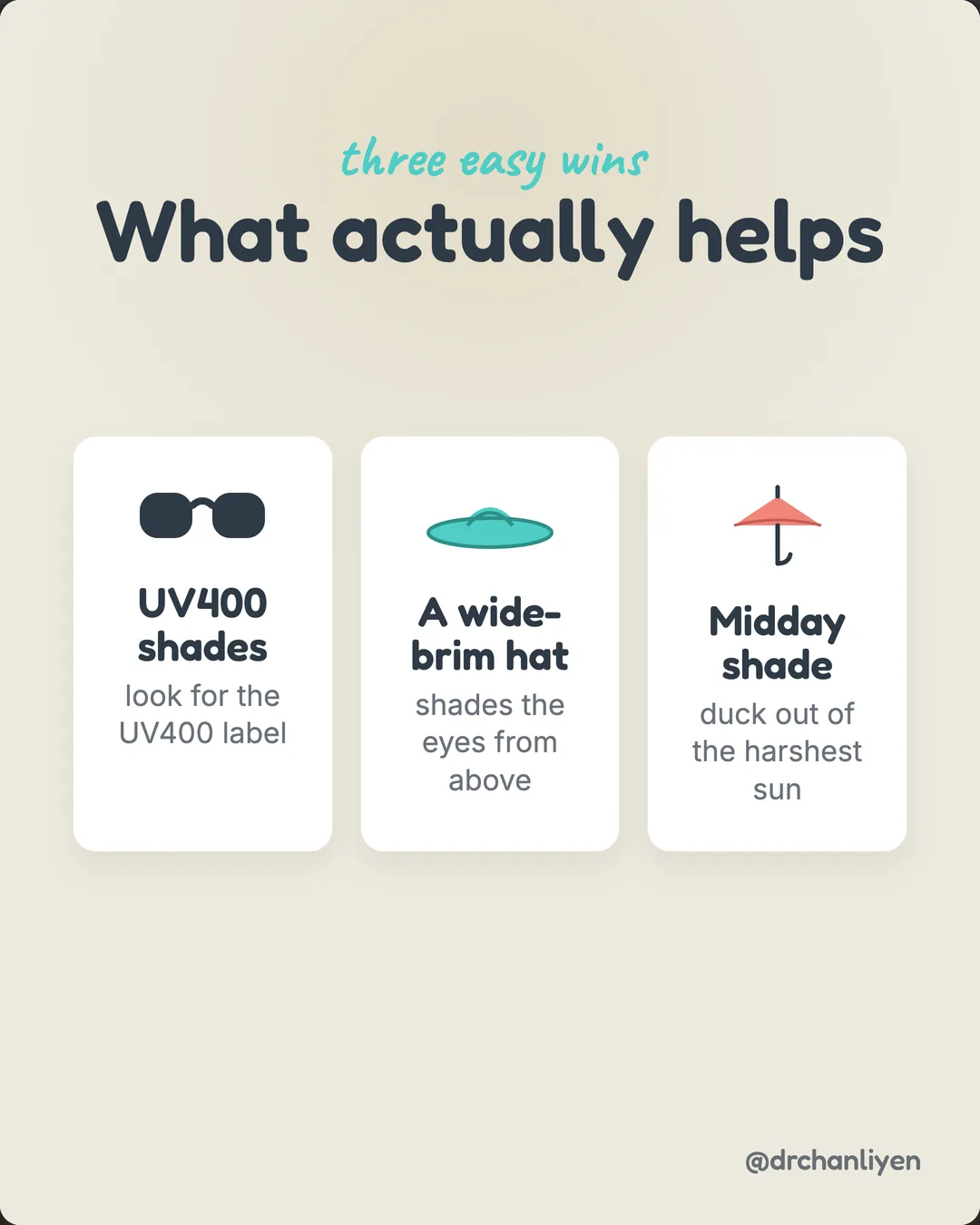
- Sun damage to the eyes builds up slowly over a lifetime and starts in childhood, so a hat with a broad brim and sunglasses labelled 100% UV or UV400 are worth the habit.
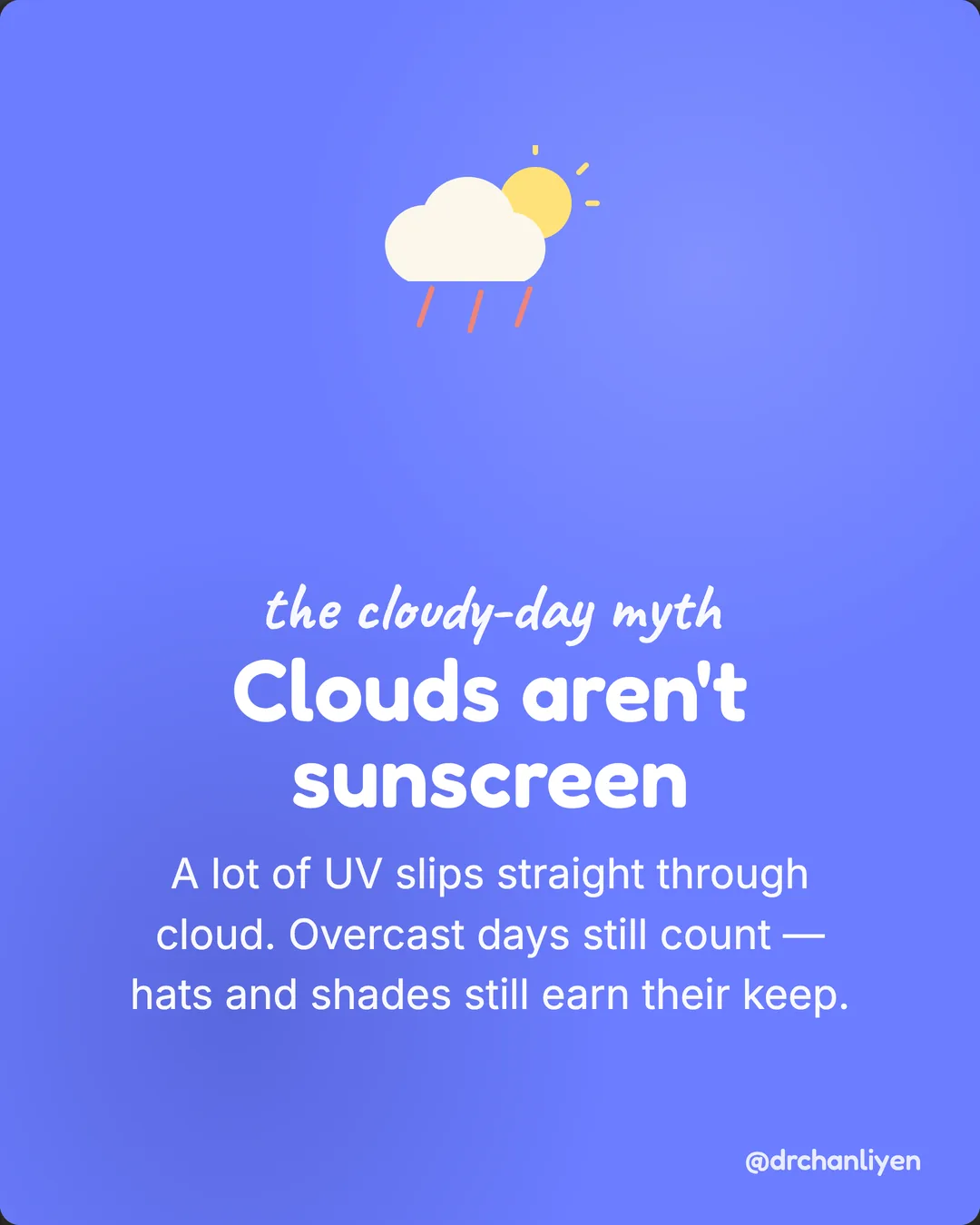
- Cloud and haze do not block UV light, so a dull sky is not a reason to leave the hat at home.
- Time outdoors is protective against short-sightedness starting in the first place, so this is about adding sun sense, not cutting outdoor time.
- A long, unprotected day at the beach or pool can give a child what is essentially sunburn of the eye, painful but usually settling within a few days.
- The one rule with no exceptions: never look directly at the sun, and ordinary sunglasses do not make a solar eclipse safe to view.
Most of the Malaysian children I see spend their weekends the way I did: a padang for football, a playground after the worst of the heat has passed, a pasar malam in the evening with the sun long gone. That is an outdoor childhood, and I am glad of it. Time outside is one of the few things with real evidence behind it for keeping short-sightedness from starting in the first place. Nothing in this article is a reason to keep a child indoors.
What I want to add on top is small and easy: a hat that does real work, sunglasses that are rated for UV, one rule about the sun itself that has no exceptions, and a calm plan for haze days. None of it should make a parent afraid of sunshine.
Can the sun really damage my child's eyes?
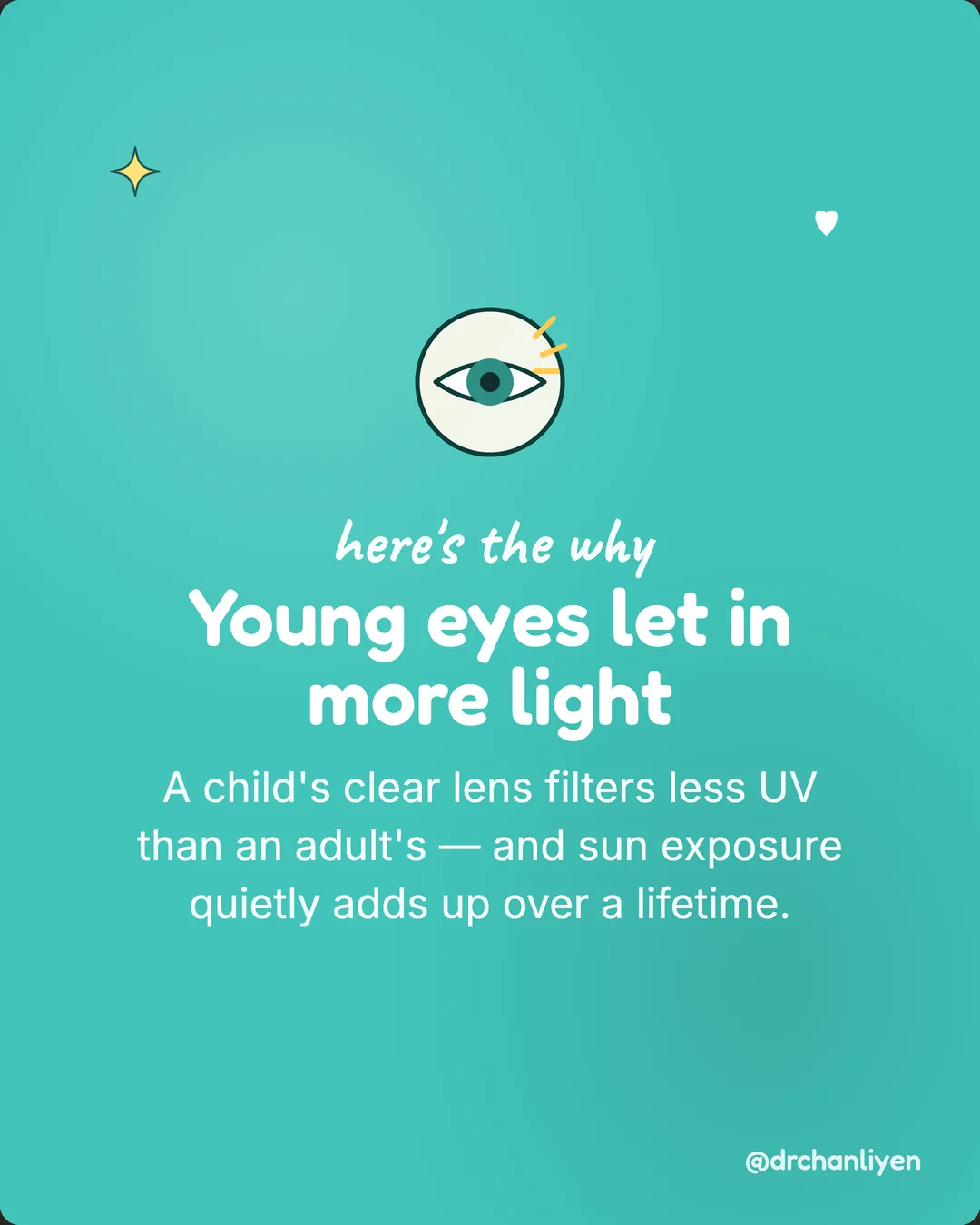
Yes, but slowly, in the same way it ages skin. Eye problems linked to sun exposure, cataracts and certain growths on the surface of the eye, take years to develop, and the risk adds up each time the eyes go unprotected in strong sun. Dr Catherine Chow explains how the adult version of those surface growths, pterygium and pinguecula, relates to years of sunlight, and when one needs removing, in a growth on the white of the eye.
Exposure is cumulative and it starts young: not a single frightening number about childhood being the danger zone. The skin around the eye is exposed to the same sun, and Dr Ong Jin Khang, who practises skin medicine at The Retreat Clinic, explains what an SPF number does and does not tell you in a tropical climate.
Because it is cumulative, none of this is about one afternoon at the pool. It is about a habit that costs a parent almost nothing: a hat within reach, sunglasses in the school bag, both used often enough that a child reaches for them without being nagged.
Does a hat help, or is it just for looks?
A broad-brimmed hat genuinely reduces the UV reaching the eyes, and it is often the piece of kit a toddler will actually keep on. Broad brim beats cap, because a cap shades the forehead well but does very little for the eyes themselves once the sun is high.
If I had to pick one battle to win on a rushed school morning, I would pick the hat. It works whether or not a child cooperates with sunglasses, it needs no fitting, and a three-year-old having a tantrum about sunglasses will usually still tolerate a hat. Sunglasses are the upgrade, not the requirement.
What should I look for when buying my child sunglasses?
One label, and nothing else matters as much: 100% UV protection, or UV400. That single line on the tag tells you the lens blocks the UV wavelengths that do the damage, regardless of how dark the tint looks or what the sunglasses cost.
This runs against instinct, so say it plainly: a very dark lens without that label can do less for a child's eye than no sunglasses at all. A dark tint makes the pupil open wider to let in more light, and if the lens is not filtering UV, a wider pupil simply lets more of it through. Check the label before you check the shade of the lens. A pair of clear-looking sunglasses correctly rated UV400 is doing more good than a beautifully dark pair with no rating printed anywhere.
If your child has just been prescribed glasses, the same UV logic applies to their everyday pair outdoors, and it is worth asking your optometrist about a UV-rated tint. For the general story of how a child's glasses prescription is measured and fitted, that is covered elsewhere on this site.
Fit matters almost as much as the label. A close-fitting, slightly wraparound frame keeps sunlight from sneaking in around the top and sides of the lens, which a small, flat pair of fashion sunglasses will not do.
This is the same logic behind the requirement that proper sunglasses meet a recognised standard, not just carry a UV number printed on a sticker. A snug, well-made pair that stays on a moving child does more good than an expensive one left in the car because it keeps sliding down a small nose.
Cloud, haze and grey skies: does the habit still apply?
Yes. Cloud does not block UV light, and neither does haze, so a grey sky is not a reason to leave the hat behind. The sun's rays pass through both. The days that feel gentlest on the eyes are sometimes delivering just as much UV as a bright one, which surprises most parents, understandably, because a hazy day looks and feels dimmer.
What has reduced is visible glare, not the ultraviolet part of sunlight that does the slow damage. Keep the hat and sunglasses habit going regardless of what the sky looks like.
On the eyes specifically, a bad haze day mainly causes irritation rather than lasting damage: gritty, reddish, watery eyes that generally settle once exposure stops. Cut outdoor time and keep play indoors until it clears. If your child's eyes are irritated, lubricating eye drops and time away from the haze usually bring relief.
Rubbing makes irritation worse, so a reminder not to rub is worth repeating in the moment, the same reminder that matters for ordinary everyday eye safety at home. And keep a mental line between ordinary haze irritation and anything more serious: if an eye becomes properly painful, very red, or vision changes rather than just feeling gritty, that is a reason to get checked rather than something to wait out.
None of this is a reason to abandon the routine checks that catch other things early either. The sun habit sits alongside, not instead of, the ordinary rhythm of a child's eye checks from infancy onward, which is a separate story with its own timing.
My child's eyes hurt after a day at the beach, what is that?
It is very likely photokeratitis, which is essentially sunburn of the surface of the eye. It follows a long stretch of unprotected sun, and sand and water make it worse because both reflect UV strongly back up into the eyes rather than just down from above.
What catches parents out is the timing. Symptoms can appear anywhere from half an hour to twelve hours after the exposure, so a child can seem completely fine on the drive home from the beach and then wake at midnight with painful, watering, light-sensitive eyes. It is genuinely uncomfortable, but the surface of the eye usually heals within one to three days with rest, shade and time.
If the pain, redness or light sensitivity has not eased within that window, or if vision seems affected, that has moved past ordinary sunburn of the eye and is worth a proper look. Sunburn of the eye has its own place among the red, light-sensitive eyes I would rather see promptly, in is this urgent?.
Is it ever safe to look at the sun, even briefly?
No, not directly, and not even for an eclipse. This is the one place in this whole topic where the harm is immediate and can be permanent, rather than slow and cumulative like the rest of sun protection. Looking straight at the sun can damage the retina, and that kind of damage does not reliably heal.
The detail worth repeating at home is that ordinary sunglasses, however dark, however well rated for everyday UV, do not make an eclipse safe to watch. Watching a partial eclipse needs purpose-made solar viewers, not a sunhat and a good pair of sunglasses. If your family is planning to watch one, that is worth arranging in advance rather than improvising with whatever is in the car.
What is worth doing, day to day?
Less than parents often fear. A broad-brimmed hat kept somewhere your child will actually find it. Sunglasses checked for a 100% UV or UV400 label before anything else about them. A firm, simple rule that the sun itself is never to be looked at directly, eclipse included. Extra caution near sand and water, since both reflect UV hard enough to catch a child out hours later. And on a hazy day, less time outside, lubricating drops if eyes turn gritty, and no rubbing.
That is all of it. It sits comfortably alongside a padang on a Saturday morning, a playground in the late afternoon and a pasar malam once the sun has gone down, and it should never be the reason a Malaysian childhood moves indoors.
- Your child's eyes are intensely painful, watering and light-sensitive many hours after a day outdoors.
- There is any chance your child looked directly at the sun or at an eclipse, even briefly.
- An eye stays red, painful or blurred for more than two or three days after sun exposure.
- Vision changes in any way after time in strong sun or near reflective water or sand.
- A hazy day leaves your child's eyes not just gritty but genuinely painful or swollen.
Common questions
Do babies and toddlers need sunglasses?
What UV rating should children's sunglasses have?
Can the sun damage my child's eyes?
Is a hat as good as sunglasses for kids?
My child's eyes hurt after a day at the beach, what is it?
Can my child look at a solar eclipse with sunglasses?
How do I protect my child's eyes during the haze?
Do children need sunglasses on a cloudy day in Malaysia?
- American Academy of Ophthalmology · Protecting your eyes from the sun's UV light · www.aao.org
- AAO EyeWiki · Photokeratitis · eyewiki.aao.org
- AAO clinical statement · Reducing the global burden of myopia by delaying onset (2021) · www.aao.org
- AAO · Prevent childhood myopia with sunshine and outdoor time · www.aao.org
- Singapore Ministry of Health · Haze health advisory for the public · www.moh.gov.sg