Styes and chalazia: the little lump on your child's eyelid
A hard lump on your child's eyelid looks alarming overnight. Almost always it is a blocked or infected gland, not a sign of anything serious, and there is a clear, calm way to handle it.

- A stye is an infected gland at the lash line and usually hurts. A chalazion is a blocked oil gland and often does not.
- Never squeeze or try to pop either one. Doing so can spread the infection into the eyelid.
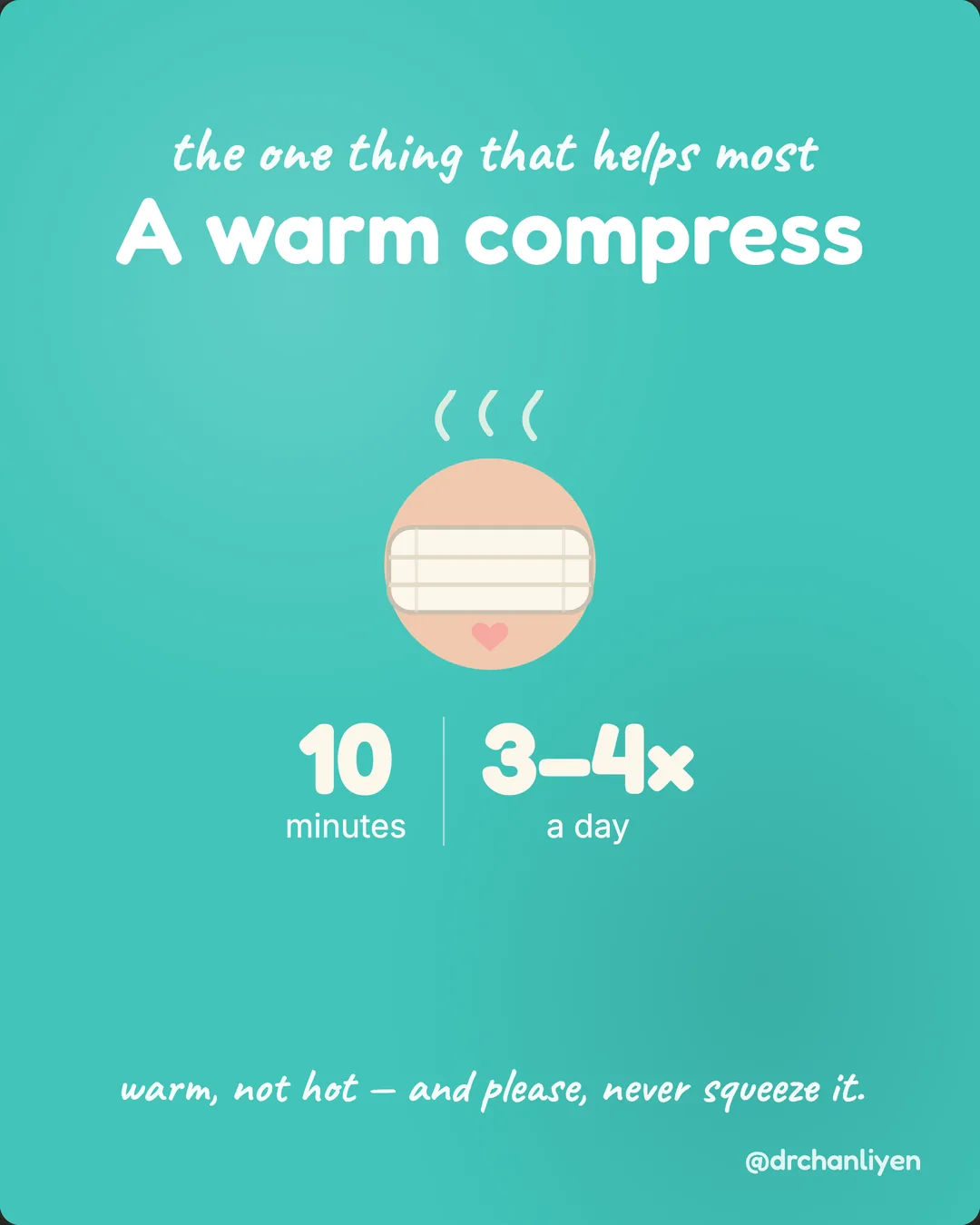
- A comfortably warm compress for roughly five to fifteen minutes, a few times a day, plus gentle lid cleaning, is the sensible first step for most children.
- Some chalazia that do not settle need a small in-clinic procedure; in a young child that is usually done under a general anaesthetic, and it is a normal, expected next step, not a failure of the first one.
- A chalazion heavy enough to visibly droop the eyelid or sit over the pupil needs a proper eye check because of the risk to that eye's vision (amblyopia), not just because of how it looks.
- See a doctor the same day if the whole lid or cheek swells and reddens, especially with fever.
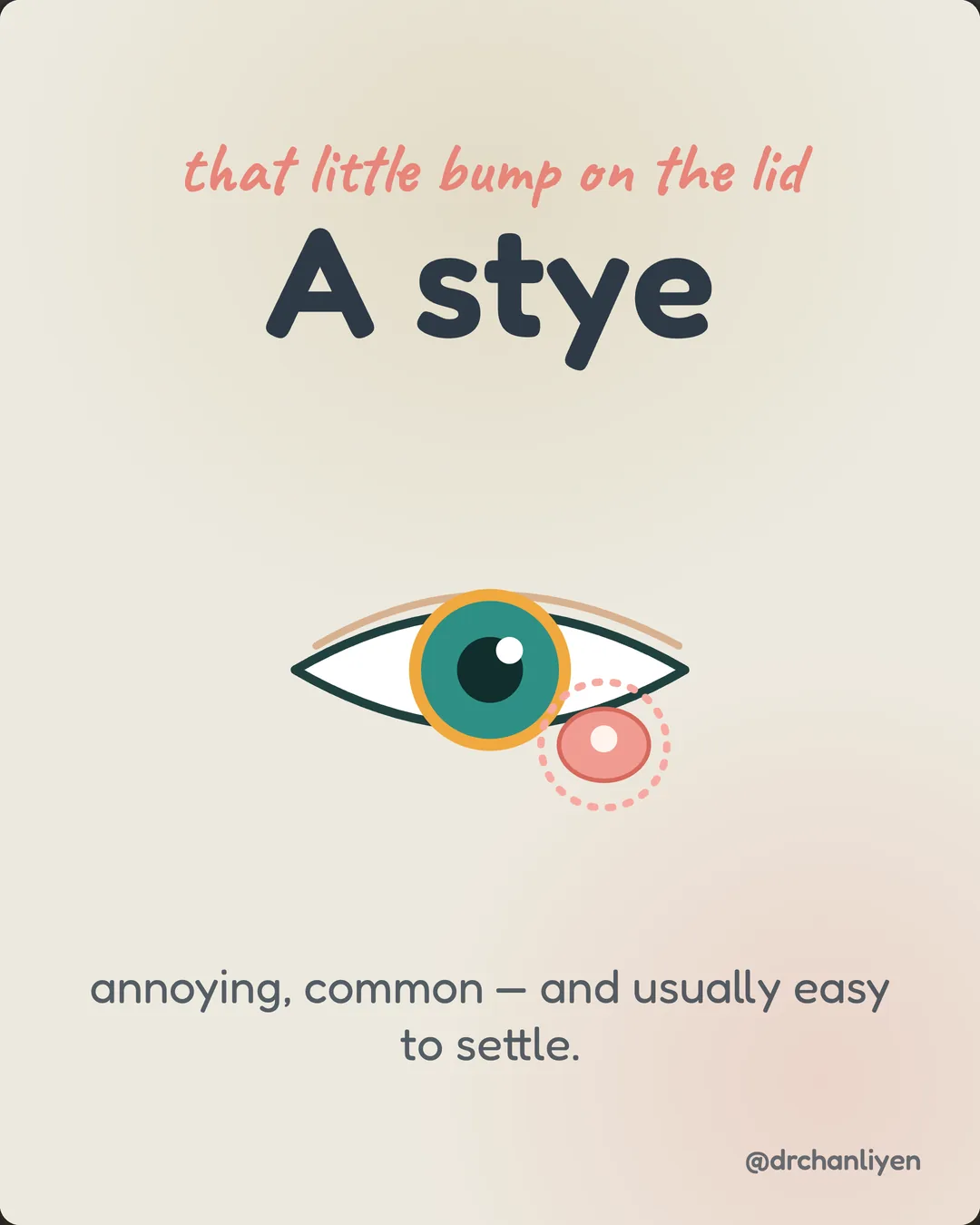
A stye arrives overnight. Yesterday the eyelid was ordinary; this morning there is a red, swollen little bump and a child who will not stop poking at it. The speed is the frightening part, and the speed is also the least meaningful part. A stye or a chalazion is one of the most common, harmless things I see in a child's eye, and it looks far worse than it is.
That gap, between how alarming the lump looks and how ordinary it is, is one I like to close early. Overnight lumps unsettle parents precisely because they appear so fast, with no warning and no obvious cause, on a part of the face we all watch closely. Below is what these lumps are, what helps, what does not, and the one pattern that does need same-day attention. The old belief about peeping is answered in ketumbit and the peeping myth.
What is the lump on my child's eyelid?
Almost always, it is a stye or a chalazion, two different problems that share a cause: a small gland in the eyelid that has become blocked or infected. Neither means anything else is wrong with your child. Both are extremely common, and both usually settle with simple care at home.
A stye, also called a hordeolum, forms when a gland at the base of an eyelash gets infected, essentially a small boil at the lash line. A chalazion forms deeper in the lid, where a tiny oil gland, one of the meibomian glands that keep the surface of the eye lubricated, gets clogged. It is the same eyelid, the same rough neighbourhood of glands, but a different mechanism, and that difference shapes what to expect next.
Stye or chalazion, what is the difference?
A stye is usually red, tender to touch, and sits right at the edge of the lid among the lashes, because it is an active infection. A chalazion tends to sit a little further back in the lid, is often firmer, and can be entirely painless. Some parents only notice a chalazion when they run a finger over the lid and feel a small, round bead under the skin.
The two are related rather than strictly separate, and some lumps sit somewhere between them. I would not spend too long trying to label it precisely at home. A photo taken each day, before and after a compress session, is often more useful to me at a follow-up visit than a precise label would be. What matters more is what you do next, and that is largely the same for both.
How do I do a warm compress on a toddler who will not sit still?
With a clean, comfortably warm washcloth, held gently against the closed eyelid for roughly five to fifteen minutes, a few times through the day. That warmth loosens the blocked or thickened contents of the gland so the body can clear it, and it is the standard first step for both a stye and a chalazion.
Different guidance gives slightly different numbers, and the studies behind chalazion treatment are thinner than parents assume. What matters is the general pattern: a comfortably warm compress for roughly five to fifteen minutes, a few times a day, done consistently over days rather than perfectly on a single afternoon.
For a wriggling toddler, do not aim for one long, heroic session. A cuddle on your lap during a favourite show, or two shorter compresses instead of one long one, works just as well and causes far less of a fight. Gentle cleaning of the eyelid margin, with cooled boiled water or a specific lid wipe, alongside the compress, also helps, particularly if your child is prone to lumps recurring, in much the same spirit as the lid care I describe for watery eyes and blocked tear ducts.
Can I squeeze my child's stye?
No. It is tempting, especially once a stye starts to look like a spot, but squeezing or trying to pop a stye or chalazion can push the infection further into the eyelid rather than out of it. It does not speed things up, and it can turn a small, contained problem into a bigger one.
The same goes for trying to remove an eyelash yourself if the stye seems to centre on one. Leave the lid alone beyond a warm compress and gentle cleaning, and let the gland resolve on its own timetable.
If your child normally wears anything near the eye, such as eye makeup for an older girl on special occasions, or contact lenses for an older child, pause it until the lump has settled; it is one less thing rubbing against an already irritated lid. It is one of the few situations where doing less is the correct medical advice, not just a way of saying there is nothing to be done.
Does my child need surgery for a chalazion?
Usually not. Many chalazia shrink and disappear over some weeks with warm compresses and lid hygiene, and no procedure is ever needed. A minority do not, and for those, a small in-clinic step, sometimes a steroid injection into the lump, sometimes a brief drainage procedure, is a normal and expected next stage, not a sign that the first approach failed.
We would consider a procedure if a chalazion is large enough to press on the eye and blur vision, if it simply refuses to shrink over weeks of proper home care, or if the same spot keeps recurring. A stye that is genuinely infected, rather than just a blocked gland, sometimes needs an antibiotic ointment or drops as well as compresses, and a chalazion that will not settle can sometimes be treated with a steroid injection into the lump instead of a drainage procedure.
A lump that keeps coming back in exactly the same spot is worth a proper look too, since repeated lesions in one place are one of the reasons we would want to examine the eyelid more closely rather than simply treating it again the same way. None of that is an emergency decision made on the spot. It is a conversation we have once we have given the ordinary approach a fair, unhurried trial.
When a drainage procedure genuinely is needed and your child is young, it is usually done under a general anaesthetic, and I would rather say that plainly here than have it come as a surprise in clinic. A general anaesthetic means your child is fully asleep for the procedure, and it is a real decision, not a small one, even though the procedure itself is short.
The reason is practical rather than dramatic: a young child cannot lie still with a clamp on the eyelid and an instrument close to the open eye the way an adult can manage under a local anaesthetic drop, so making the drainage safe for a child means making the child asleep for it.
The operation itself usually takes around ten minutes, is done as a day case, and your child goes home the same day, often within a few hours. That is worth knowing honestly and without drama: a general anaesthetic is a genuine thing to weigh, not a routine formality, and it is also a short, well-established procedure that most children come through without difficulty.
There is one version of a large chalazion I take seriously beyond blurred vision alone: a lump heavy enough to visibly droop the eyelid, or to sit directly over the pupil. A drooping or heavy lid can, over time, affect how that eye's vision develops, what we call amblyopia or a lazy eye, in the same way any lid that blocks or distorts the view out of one eye can.
This is not a reason to worry over an ordinary small lump. It is a reason to have a lump examined rather than left to home care indefinitely if it is genuinely heavy enough to change how the eyelid sits, because the timing of any treatment then depends on protecting how that eye sees, not on how the lump looks.
Why does my child keep getting styes?
Some children's eyelid glands simply block or infect more easily than others, and eye rubbing is often part of the picture. A child who rubs a lot, whether from tiredness, allergy, or the kind of frequent rubbing I write about separately in why children rub their eyes so often, tends to irritate the lid margin and the glands within it.
Keeping the eyelid edges clean, discouraging habitual rubbing where you reasonably can, and treating any underlying eyelid inflammation are the practical levers here. A washcloth with a little baby shampoo, or a specific lid wipe, run gently along the lash line once a day, is usually enough for a child whose lids look a little inflamed generally, not just at the site of one lump. Some children are simply more prone to these lumps than others, in the same way some children get more ear infections.
When is a swollen eyelid in a child an emergency?
When the redness and swelling spread beyond the lump itself to the whole eyelid, or onto the cheek, especially alongside a fever. That combination suggests the infection has moved beyond the gland into the deeper tissue around the eye, and it needs to be seen the same day, not at the next routine appointment.
Other signs that belong in the same category are an eye that looks pushed forward compared with the other, pain when your child moves the eye rather than just the lid, or a noticeable change in how well they seem to see.
Any of these, on their own or together, is different from an ordinary stye or chalazion and deserves prompt medical attention, not a wait-and-see week of compresses. It helps to know this distinction in advance, in the same way it helps to know the signs I describe in pink eye in children, because a calm parent who recognises the difference acts faster than one who is guessing.
Where that pattern sits among the other same-day signs is set out in is this urgent?, entry by entry.
Recurrence is read differently in an adult, and it is worth a sentence here because parents so often have these lumps themselves. In a child, a lump that keeps returning is almost always a gland behaving badly. In adult skin, a lump that recurs in exactly the same spot, or one that never fully settles, is the situation in which a biopsy gets considered, because a small number of adult eyelid lesions turn out not to be chalazia at all.
Dr Catherine Chow covers when an eyelid lump in an adult needs looking at properly rather than treating again. For children that threshold sits somewhere quite different, so this is not a worry to carry on your child's behalf.
Outside of that pattern, though, take the lump for what it almost always is: a small blocked gland, the kind a warm cloth and a little patience can handle.
what you may hear at home
- Can I put breast milk, toothpaste or a warm spoon on it?
Nothing goes on the eyelid except a clean, warm, damp cloth. Toothpaste and other household remedies irritate skin that is already inflamed, and a hot spoon risks a burn on the thinnest skin on the body. Breast milk has a long history in Malaysian households for eye problems and I would still leave it out of this one. Warm water and a clean flannel are the whole toolkit.
- My mother says it will burst by itself, should I just wait?
Waiting is right, bursting is not something to help along. Most styes do settle within about a week with warmth alone, and one that opens on its own while you are compressing it is doing what it should. What you must not do is speed it up with a pin, a fingernail or a squeeze, because that pushes infection sideways into the lid. If it has not shifted after a few weeks, show it to a doctor rather than giving it another month.
- Can she still go to tadika with a ketumbit?
Yes, and I do not ask families to keep a child at home for one. The sensible precautions are the ones the NHS lists: her own towel and her own flannel, nobody else using them, and clean hands before anyone touches the eye. Tell her teacher it is there so that nobody encourages her to rub or pick at it during the day.
The ketumbit myth →
- The redness and swelling spread beyond the lump to the whole eyelid or the cheek.
- Your child has a fever alongside the swollen eye.
- The eye looks pushed forward, or moving it seems to hurt.
- Your child's vision seems reduced, or they are seeing double.
- The lump is heavy enough to visibly droop the eyelid, or appears to sit directly over the pupil, even without redness spreading further.
- The lump has not started to settle after a few weeks of home care.
Common questions
What is the lump on my child's eyelid?
Stye or chalazion, what is the difference?
How long does a chalazion take to go away in a child?
How do I do a warm compress on a toddler who will not sit still?
Can I squeeze my child's stye?
Does my child need surgery for a chalazion?
Will my child need a general anaesthetic for a chalazion?
Why does my child keep getting styes?
When is a swollen eyelid in a child an emergency?
- American Academy of Ophthalmology · What are chalazia and styes? · www.aao.org
- AAPOS · Chalazion · aapos.org
- NHS · Stye · www.nhs.uk
- American Academy of Ophthalmology EyeNet · Chalazion management, evidence questions · www.aao.org
- American Academy of Ophthalmology EyeWiki · Preseptal cellulitis · eyewiki.aao.org
- Evelina London (Guy's and St Thomas' NHS Foundation Trust) · Your child's incision and curettage procedure to treat a lump on the eyelid (chalazion) · www.evelinalondon.nhs.uk
- AAPOS · Ptosis · aapos.org